

Car fuses are tiny components that most drivers never think about until something suddenly stops working. One day your radio is fine, and the next day it goes silent. Your headlights, power windows, cigarette lighter, or interior lights can all stop working because of one tiny plastic piece smaller than your thumb. That small part is the fuse, and despite its size, it acts like a bodyguard for your car’s electrical system. Without it, your vehicle’s wiring could overheat, melt, or even cause a fire.
Think of a fuse like the emergency brake in your home’s electrical system, except it’s specific to each circuit in your vehicle. When too much electrical current flows through a circuit, the thin metal strip inside the fuse melts intentionally, cutting power before damage spreads. According to recent automotive maintenance guides from O’Reilly Auto Parts and CARFAX, overloaded circuits, incorrect fuse ratings, and short circuits remain the most common reasons for blown automotive fuses.
Modern vehicles have dozens of electrical circuits. Your horn has one. Your windshield wipers have one. Your infotainment system has one too. Manufacturers separate these systems so one problem doesn’t knock out the entire vehicle. That’s why understanding fuses isn’t just for mechanics anymore. If you own a car, learning how to inspect and replace a fuse is almost as practical as learning how to check tire pressure.
A blown fuse is often the electrical equivalent of a circuit saying, “Something’s wrong, and I’m shutting this down before things get ugly.” That’s actually good news. The fuse sacrificed itself to save something far more expensive.
Why Car Fuses Blow in the First Place
A fuse doesn’t usually blow just to annoy you on a Monday morning. It blows because the circuit experienced a problem serious enough to trigger protection. The most common culprit is a short circuit, which happens when electricity takes an unintended shortcut. Instead of flowing neatly through the designed wiring path, power jumps where it shouldn’t, often due to exposed wire touching metal.
Damaged insulation is a major cause. Over time, heat, vibration, moisture, and age can wear down protective wire coatings. Imagine electrical wires like garden hoses. If the hose cracks, water leaks everywhere. In your car, if wire insulation cracks, electricity escapes and chaos follows. That escaped current can instantly overload a fuse.
Overloads are another common reason. Plugging a device that draws too much power into a 12V socket can overload the circuit. Cheap phone chargers, portable air compressors, or aftermarket accessories are repeat offenders. Automotive experts note that accessories pulling more current than the factory circuit was designed for often lead to repeated fuse failure.
Corrosion also deserves blame. Water intrusion into fuse boxes or connectors creates resistance and unpredictable current behavior. Moisture is like inviting electrical gremlins into your wiring harness. Rusty terminals can create poor connections, heat buildup, and eventual fuse failure.
Sometimes, though, the fuse itself is the wrong rating. Installing a lower-amperage fuse than required means it may blow even when the system is functioning normally. Installing a higher-amperage fuse is worse; it’s like replacing a home smoke detector with a decorative rock. It won’t protect anything.
Locating the Correct Fuse Box for the Problem
Before you can remove a fuse, you need to find it. Sounds obvious, but many cars have multiple fuse boxes hiding like they’re in witness protection.
Most vehicles have at least two fuse boxes. One is usually under the hood, near the battery or engine bay. This box typically contains high-amperage fuses for critical systems like cooling fans, ABS modules, engine controls, and headlights. Open the hood, and you’ll often see a black plastic box labeled “FUSE/RELAY.”
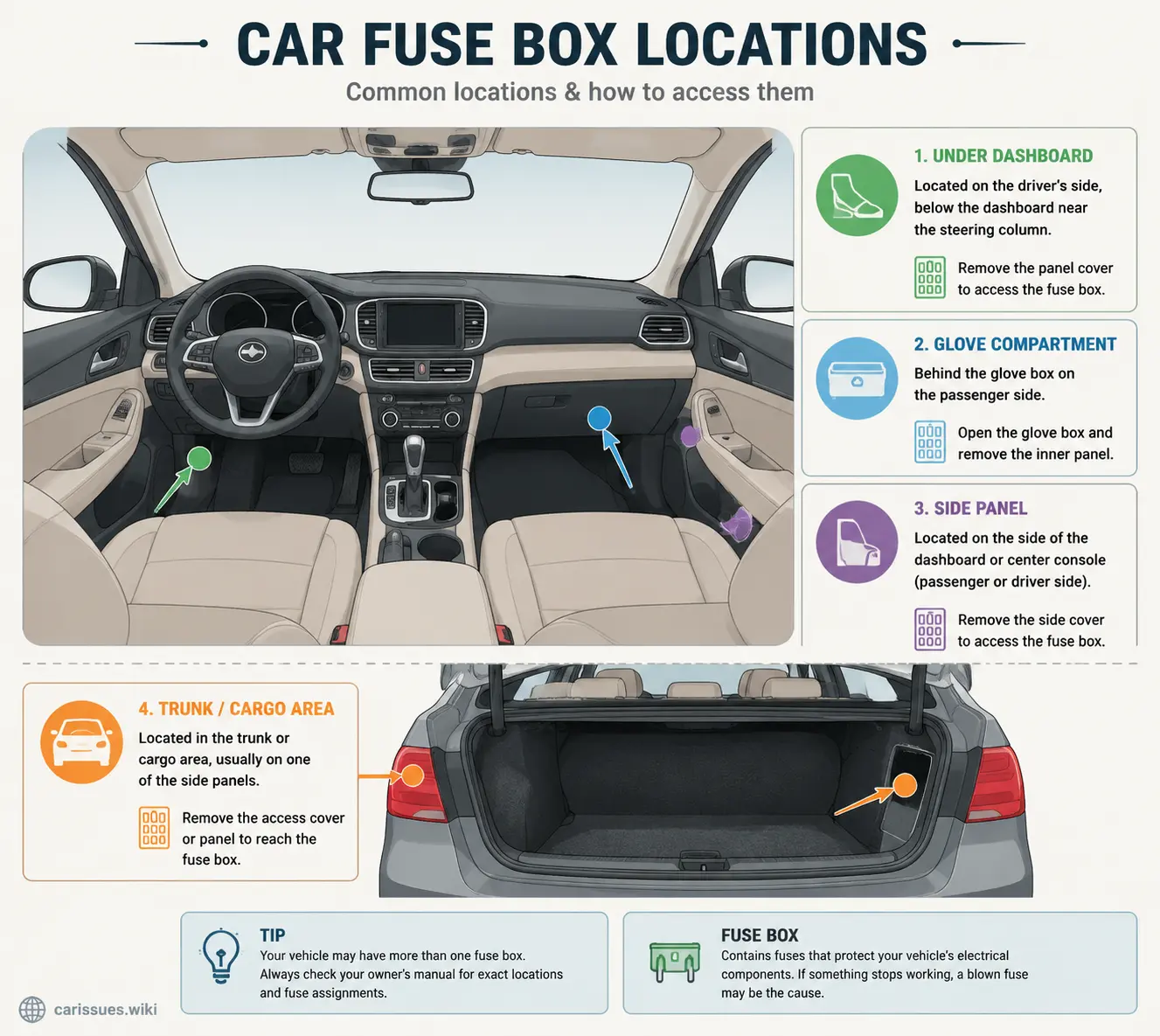
The second fuse box is usually inside the cabin. Common locations include:
- Under the dashboard
- Beside the steering wheel
- Behind a side panel
- Inside or beneath the glove compartment
- Occasionally in the trunk
CARFAX notes that owner manuals remain the fastest way to identify exact fuse locations because manufacturers love creativity when hiding them.
Here’s a quick location guide:
| Vehicle Area | Common Fuse Box Purpose |
|---|---|
| Engine bay | Engine electronics, fans, headlights, ignition |
| Driver dashboard | Windows, locks, radio, lights |
| Passenger glove box | Accessories, infotainment, climate control |
| Trunk/rear panel | Audio systems, rear lights, power modules |
If your power windows stopped working, don’t start under the hood first. Think logically about the failed system. Cabin-related issues usually live in the interior fuse panel.
It helps to approach diagnosis like detective work. Don’t randomly pull fuses like you’re defusing a movie bomb.
Reading Fuse Diagrams Without Confusion
Fuse diagrams can look intimidating at first. Tiny symbols, abbreviations, and grids often resemble a treasure map designed by engineers who hate fun.
The good news? Once you know what to look for, diagrams become surprisingly logical.
Most fuse box covers include a printed diagram showing:
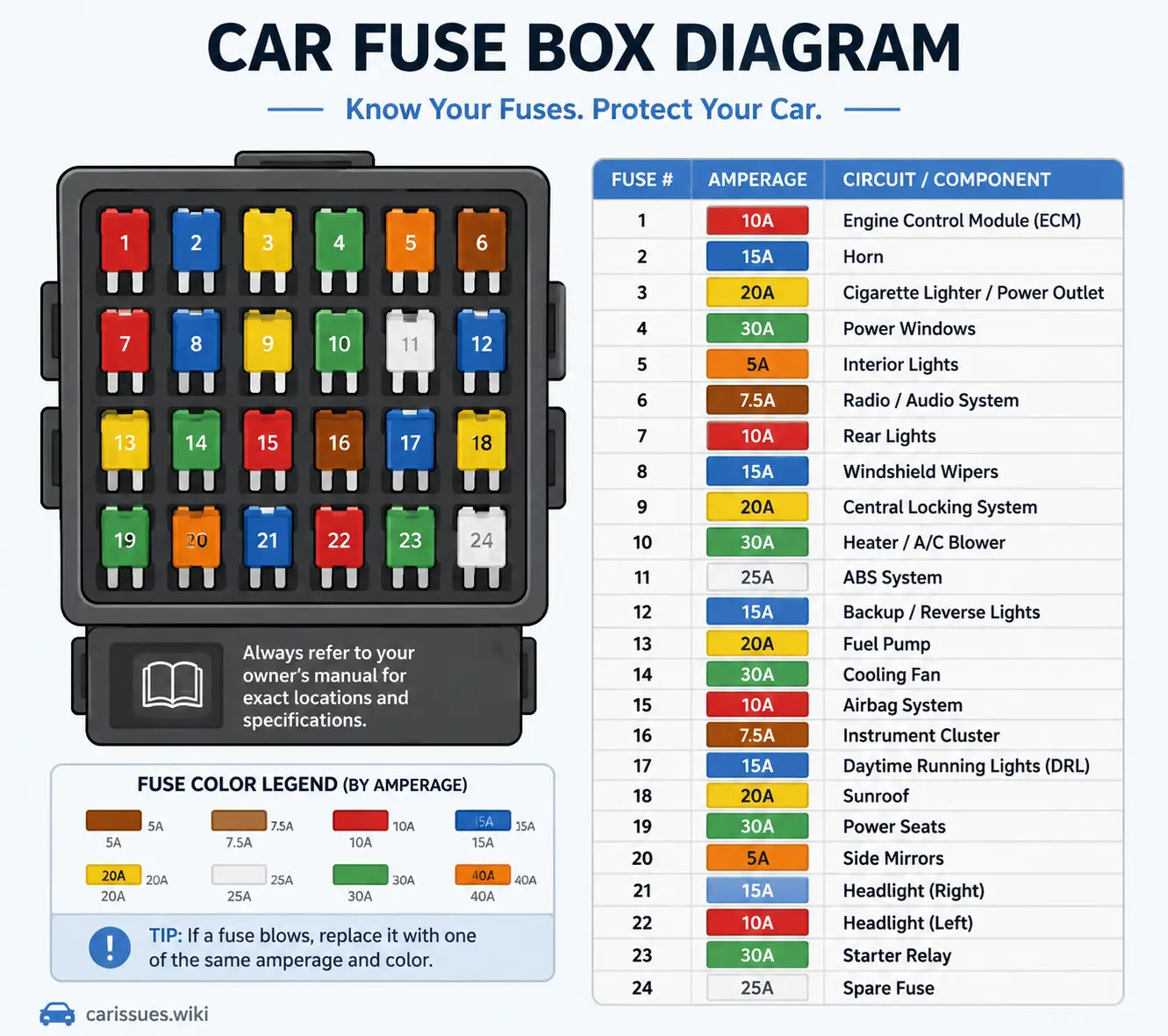
Fuse number
- Protected circuit
- Amperage rating
For example:
| Fuse Number | Circuit | Rating |
|---|---|---|
| F12 | Radio | 15A |
| F7 | Power windows | 25A |
| F21 | Horn | 10A |
Colors also matter. Automotive blade fuses are color-coded by amperage:
| Color | Amperage |
|---|---|
| Red | 10A |
| Blue | 15A |
| Yellow | 20A |
| Clear | 25A |
| Green | 30A |
A common beginner mistake is matching only the physical size. That’s a trap. Two fuses may fit identically while carrying completely different amperage.
Abbreviations can also confuse people:
- ACC = accessory
- IGN = ignition
- HVAC = heating and air conditioning
- ECU = engine control unit
Treat the fuse diagram like a hotel directory. You’re not memorizing the whole building; you just need room number access.
Safe Ways to Remove a Fuse Without Damage
Now to the actual task: getting the fuse out.
Turn the vehicle off first. Ideally, remove the key and switch off accessories. This reduces the risk of accidental shorts.
Most fuse boxes include a tiny plastic fuse puller clipped inside the lid. It looks like tweezers designed by a minimalist engineer. Grip the fuse firmly and pull straight upward.
Steps:
- Identify the correct fuse.
- Grip using fuse puller.
- Pull gently without twisting aggressively.
If you don’t have a fuse puller, needle-nose pliers can work; but carefully. Too much pressure can crack the plastic housing or damage surrounding terminals.
Never use:
- Screwdrivers for prying
- Metal picks
- Excessive force
Removing a fuse should feel more like unplugging a USB stick than extracting a stubborn tooth.
Some low-profile mini fuses are annoyingly tight. Wiggle gently while pulling upward. Patience beats brute force here every time.
How to Tell If a Fuse Is Actually Blown
Not every electrical issue is a fuse problem. Sometimes people replace perfectly healthy fuses and wonder why nothing changed.
Visual inspection is easiest. Hold the fuse to light and inspect the metal strip inside.
Signs of failure:
- Broken metal bridge
- Black soot
- Melted or cloudy plastic
- Burn marks
RAC and Car.co.uk both note these as the clearest visible signs of a failed automotive fuse.
A good fuse has an intact metal bridge. A blown fuse looks like someone snipped the wire inside.
If visual inspection is unclear, test electrically.
Using a multimeter:
- Set to continuity mode
- Touch probes to both fuse terminals
- Listen for beep or check resistance
No beep? Likely blown.
A test light is another option. Probe both exposed fuse terminals while circuit power is on. If one side lights and the other doesn’t, the fuse is bad.
Testing beats guessing every time.
Replacing Fuses With the Correct Amperage
This is where many DIYers get reckless.
Never replace a fuse with a higher amperage “just to stop it blowing again.”
That is not a clever workaround. It’s an invitation for melted wires, damaged modules, or electrical fire.
If a 15A fuse keeps blowing, replacing it with 25A doesn’t solve the underlying issue. It simply delays failure until something more expensive breaks.
Always match:
- Same amperage
- Same size
- Same style
Example:
- Mini blade → replace with mini blade
- 15A blue → replace with 15A blue
Automotive experts strongly warn against oversizing fuses because wiring is engineered for specific load limits.
A fuse is designed to fail first. Let it do its job.
Electrical Problems That Keep Blowing New Fuses
If your replacement fuse blows immediately, that’s your car waving a red flag.
Possible causes:
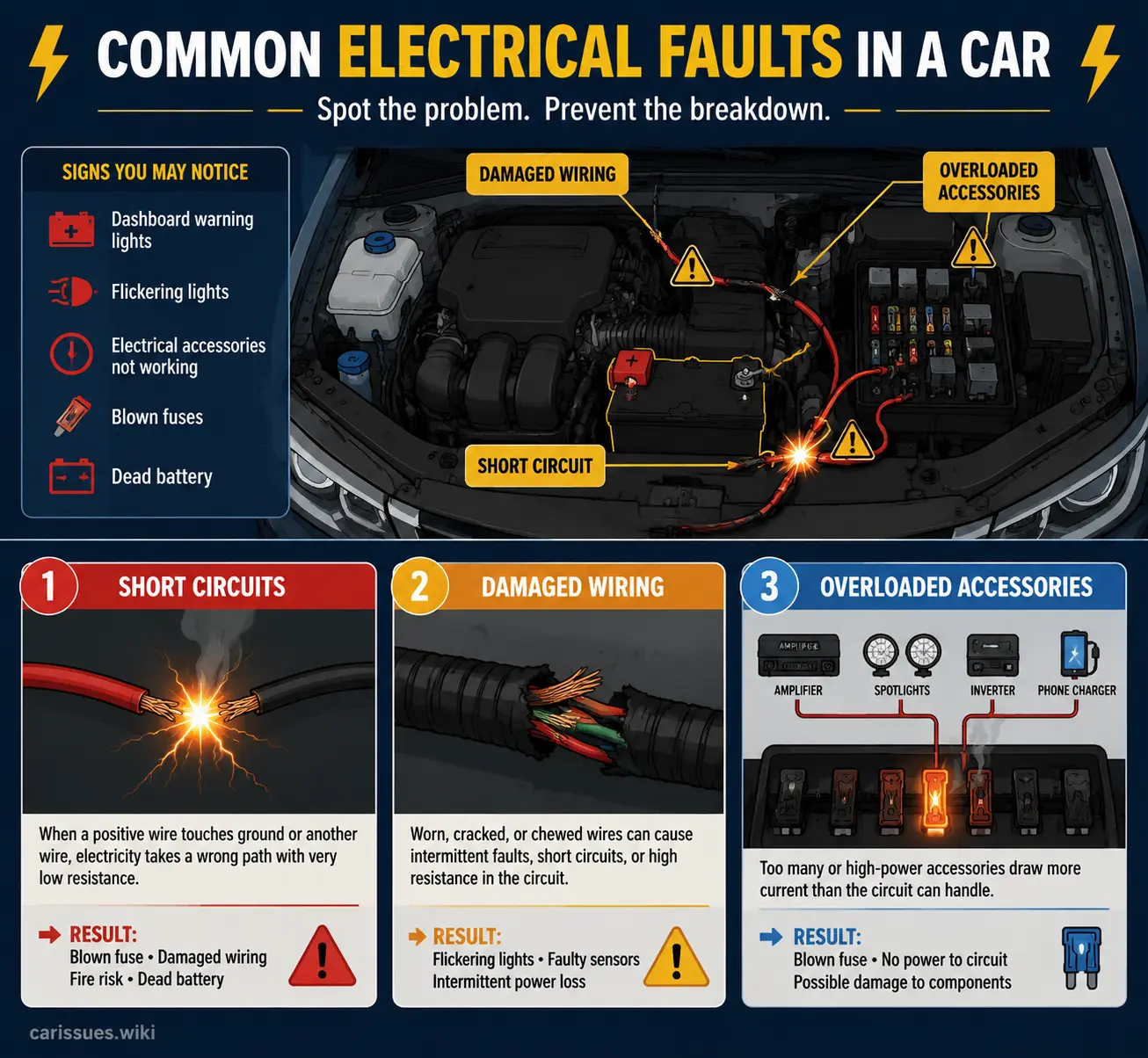
Short to ground
- Failed motor
- Damaged harness
- Pinched wire
- Faulty aftermarket accessory
Example: a failing blower motor may draw excess current repeatedly. Replacing the fuse won’t solve that.
Recurring fuse failure means the fuse is symptom, not disease.
Think of it like repeatedly taking painkillers for a broken ankle. You’re treating the alarm, not the injury.
Disconnecting accessories one by one can help isolate the issue.
Common repeat offenders:
- Stereo installations
- Dash cams
- LED conversions
- Phone chargers
- Trailer wiring
When a Larger Wiring Issue May Be Hiding Behind a Simple Fuse Failure
Sometimes a blown fuse is just the tip of the iceberg.
Warning signs of deeper issues:
- Multiple unrelated systems failing
- Burning smell
- Flickering lights
- Repeated dead battery
- Melted fuse terminals
These suggest harness damage, bad grounds, alternator voltage issues, or module faults.
At this point, DIY becomes less practical. Electrical diagnosis can quickly turn into spaghetti archaeology.
A professional technician can use:
- Wiring diagrams
- Current draw testing
- Voltage drop analysis
- Scan tools
Yes, paying for diagnosis is annoying. Paying for an electrical fire is worse.
Conclusion
Learning how to get fuses out of a car is one of those small automotive skills that pays off repeatedly. It saves time, prevents unnecessary shop visits, and gives you more confidence when something electrical stops working. The process itself is simple: locate the correct fuse box, read the diagram, remove the fuse safely, inspect it, and replace it with the exact match.
The bigger lesson is this: fuses rarely fail without reason. A blown fuse is often a messenger. Sometimes the message is harmless, like a one-time overload. Other times, it’s warning you about wiring damage or failing components.
Treat fuses like smoke alarms for your vehicle’s electrical system. Ignore them, and small issues can become expensive fast.
FAQs
1. Can I remove a car fuse without disconnecting the battery?
Usually yes if the ignition is off, but disconnecting the battery is safer for sensitive circuits.
2. What happens if I put the wrong fuse in my car?
A lower fuse may blow quickly. A higher fuse can damage wiring or start an electrical fire.
3. How much does it cost to replace a blown fuse?
Most automotive fuses cost between $1 and $10 depending on type and quantity pack.
4. Why does my new fuse keep blowing immediately?
There is likely an active short circuit, overloaded component, or wiring fault.
5. Can a blown fuse stop a car from starting?
Yes, if the blown fuse affects ignition, fuel pump, ECU, or starter-related circuits.

Marco Vestri is a 29-year-old American content writer based in Spokane, Washington. He specializes in creating well-researched automotive maintenance guides, troubleshooting articles, and practical ownership advice for everyday drivers. His work emphasizes accuracy, clear explanations, and reliable sources, helping readers make informed decisions with confidence. As a regular contributor to carissues.wiki, Marco combines years of blogging experience with a passion for simplifying complex vehicle topics into useful, trustworthy content for a broad audience.