
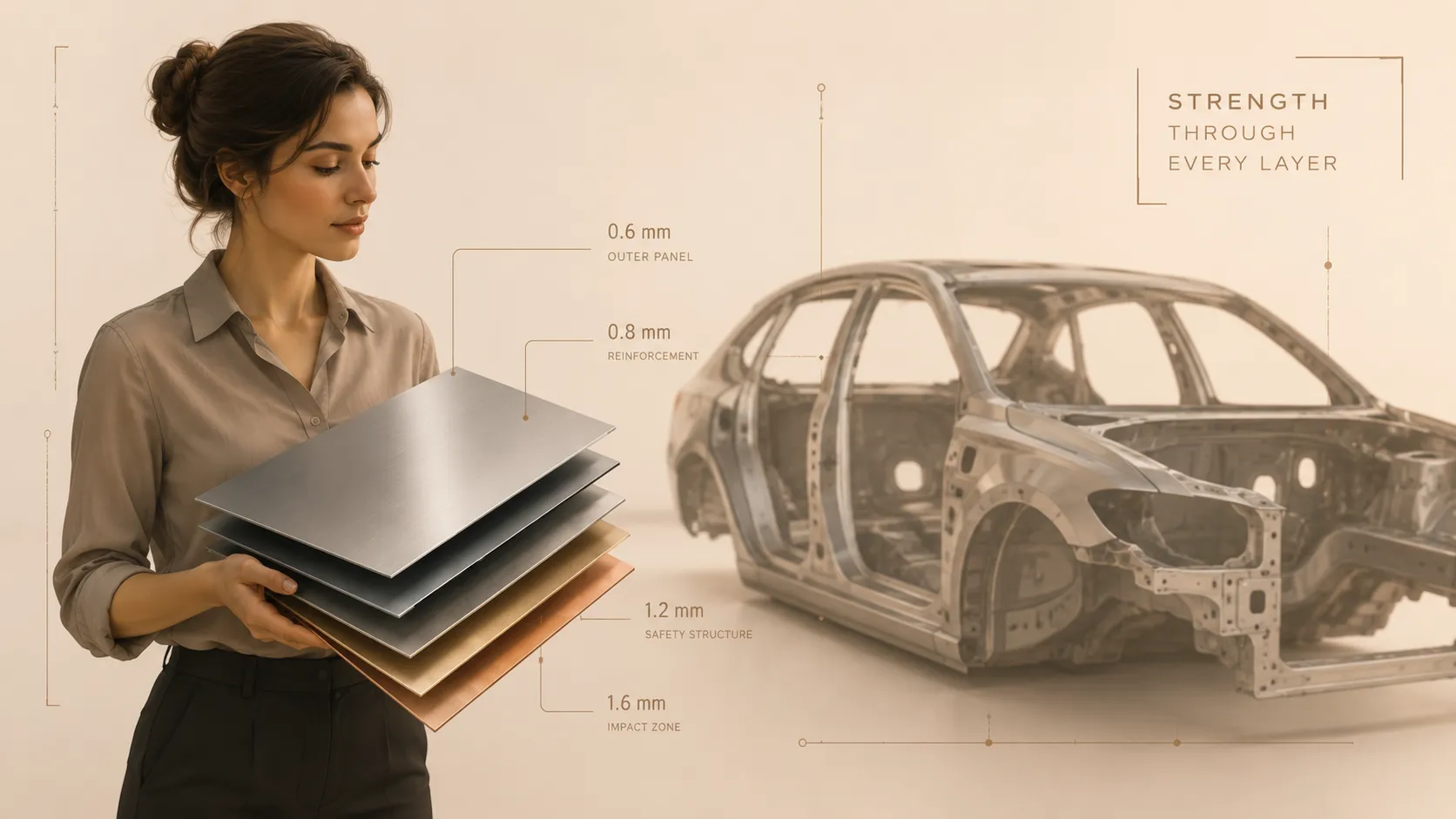
Modern cars may look sleek and lightweight from the outside, but beneath the paint lies a carefully engineered mix of metals with varying thicknesses. Automakers do not use one universal sheet metal thickness across an entire vehicle. Instead, every panel, frame section, and reinforcement area is designed with a specific purpose in mind. A hood needs to be light enough to open easily. A door beam must absorb impact energy. A roof panel should resist deformation without adding unnecessary mass. That balancing act between strength, safety, efficiency, and manufacturing cost is what shapes automotive sheet metal design today.
Recent automotive engineering references show that most passenger vehicle exterior panels typically range from 20 to 22 gauge steel, while structural areas often use 14 to 18 gauge high-strength steel depending on the application. The move toward advanced high-strength steel (AHSS), aluminum, and lightweight composites has allowed manufacturers to reduce thickness while improving crash safety and fuel economy.
Before diving into the details, it helps to understand how the automotive industry organizes sheet metal thicknesses.
Understanding Automotive Sheet Metal Gauges
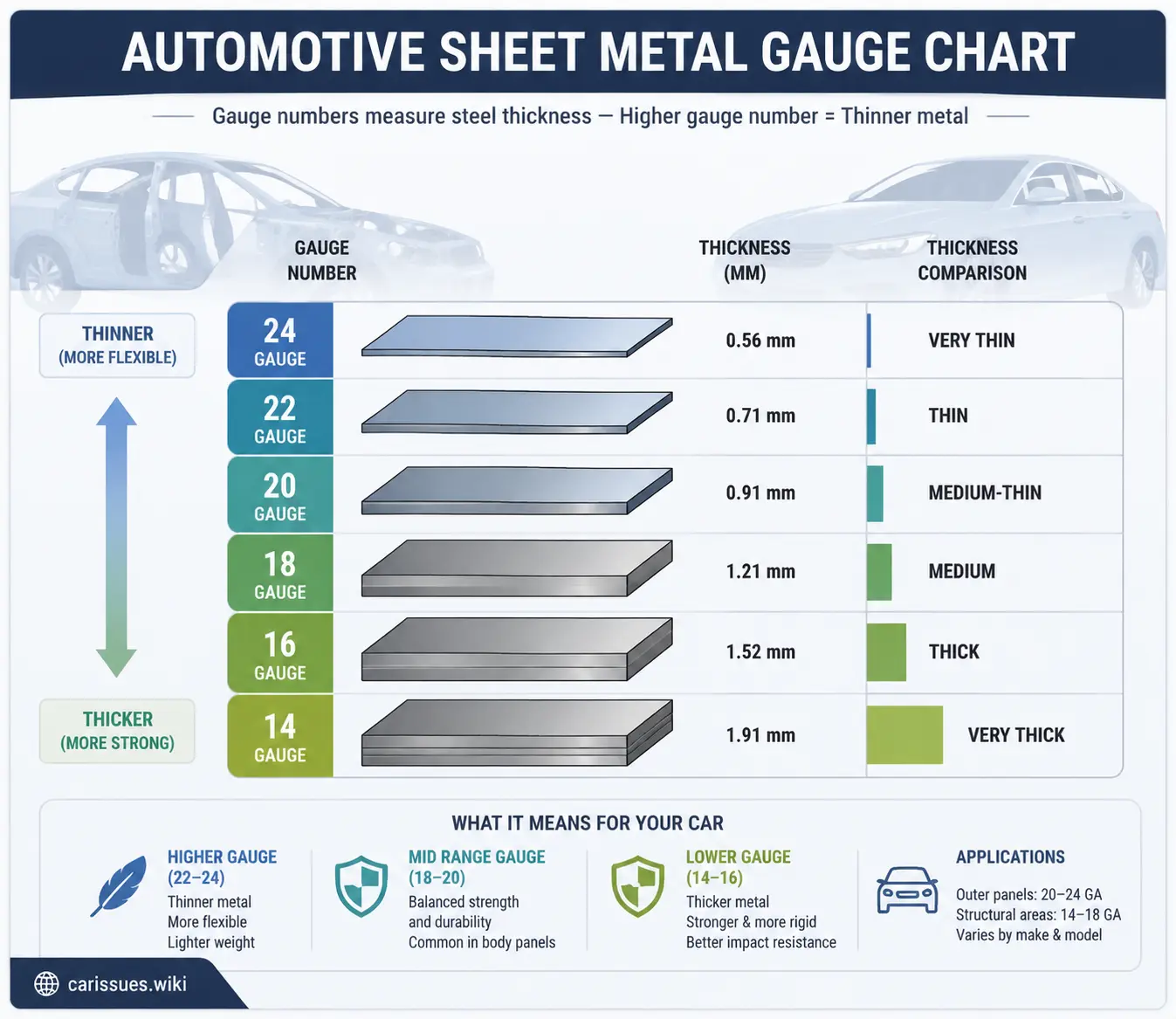
When people ask how thick sheet metal on a car really is, the answer usually starts with the automotive gauge system. This system can feel backwards at first because smaller gauge numbers actually represent thicker metal. A 16-gauge steel panel is significantly thicker than a 22-gauge panel. That confusion trips up plenty of beginners, especially DIY restorers and first-time welders. Automotive manufacturers, collision repair shops, and fabrication specialists still use gauges because they provide a quick reference for material selection, even though millimeters and inches offer more precise measurements.
Most modern passenger cars use sheet metal ranging from around 0.6 mm to 2.0 mm thick, depending on the location. Exterior body panels such as roofs and fenders are commonly thinner, while structural supports use heavier materials. Industry guides published in 2025 and 2026 show that roof panels and hoods often fall between 20 and 22 gauge, while floor pans and rocker panels frequently use 16 to 18 gauge steel. The thickness differences are intentional, not random. Every millimeter added to a vehicle increases weight, which directly affects fuel economy, handling, acceleration, and emissions.
What makes things even more complicated is that gauge thickness changes depending on the metal itself. A 20-gauge aluminum panel does not match the thickness of 20-gauge steel. Manufacturers therefore rely heavily on exact millimeter measurements during production. According to engineering references, modern fabrication shops increasingly prefer metric dimensions because gauge terminology can vary across industries and materials. That shift toward metric precision reflects how advanced automotive manufacturing has become in recent years.
Why Lower Gauge Numbers Mean Thicker Metal
The gauge system originated during the industrial era when metal thickness was associated with manufacturing processes rather than standardized measurements. Over time, the numbering system stuck around even though it makes little intuitive sense today. Smaller gauge numbers indicate fewer rolling passes during production, which resulted in thicker material. That historical quirk still shapes automotive terminology today.
Typical Gauge Ranges Found on Modern Cars
Here is a simplified comparison table for common automotive sheet metal thicknesses:
| Vehicle Component | Typical Gauge | Approximate Thickness |
|---|---|---|
| Roof panels | 20–22 gauge | 0.65–0.88 mm |
| Fenders | 20–22 gauge | 0.65–0.88 mm |
| Door outer skins | 18–20 gauge | 0.88–1.22 mm |
| Quarter panels | 18–20 gauge | 0.88–1.22 mm |
| Floor pans | 16–18 gauge | 1.22–1.52 mm |
| Frame rails | 14–16 gauge | 1.52–1.83 mm |
These ranges vary by manufacturer, vehicle type, and material choice.
Why Different Parts of a Car Use Different Metal Thicknesses
A car is not built like a solid metal box. It behaves more like a carefully choreographed system where every component plays a different role during normal driving and during a crash. Exterior body panels mainly serve cosmetic and aerodynamic functions. Structural components, on the other hand, form the protective skeleton that keeps passengers safe. Because these jobs differ dramatically, automakers intentionally vary metal thickness across the vehicle.
Take the hood as an example. Manufacturers want it light enough for easy operation while still remaining rigid at highway speeds. Thin sheet metal combined with internal reinforcement ribs accomplishes that goal efficiently. If the hood were built using thick structural steel, it would become unnecessarily heavy and potentially dangerous during pedestrian impacts. The same principle applies to trunk lids and roof panels. Thin outer skins reduce total vehicle mass while shaped contours provide stiffness.
Structural components tell a different story. Rocker panels, pillars, crash beams, and frame rails experience tremendous forces during collisions. These areas require thicker materials and often use advanced high-strength steel rather than conventional mild steel. Modern safety engineering focuses heavily on controlled deformation. During an accident, some sections are designed to crumple progressively while the passenger safety cell remains rigid. That strategy absorbs crash energy before it reaches occupants.
This balance explains why many people mistakenly believe older cars with thick steel bodies were safer. In reality, modern vehicles often protect occupants far better because their structures are engineered to manage impact forces intelligently. A rigid old car may survive visually, but occupants absorb more of the collision energy. Modern designs sacrifice exterior panels to preserve human lives.
Exterior Panels Prioritize Weight Reduction
Thin exterior sheet metal helps reduce total vehicle mass. Lower weight improves acceleration, braking, fuel economy, and electric vehicle battery range. Automakers shave kilograms wherever possible because efficiency standards continue to tighten globally.
Structural Components Focus on Safety
Structural areas must maintain integrity during crashes. That is why automakers use thicker gauges, reinforcements, and high-strength alloys in pillars, rocker panels, and impact zones. Safety engineering matters far more than simple thickness alone.
The Balance Between Vehicle Strength and Weight
Designing a modern car feels a bit like building a bridge out of paperclips and titanium at the same time. Engineers constantly fight competing goals. Customers want safer vehicles, but they also want better fuel economy and longer EV range. Governments demand lower emissions. Drivers expect strong handling and quiet cabins. Every extra pound of steel works against those objectives.
Vehicle weight directly affects efficiency. Heavier cars need more energy to accelerate and maintain speed. In gasoline-powered vehicles, that means increased fuel consumption. In electric vehicles, it reduces battery range. Recent manufacturing trends therefore focus on reducing weight without compromising crash performance. Advanced high-strength steel allows thinner materials to achieve equal or greater structural strength compared to older thicker steel designs.
Crash safety adds another layer of complexity. A vehicle cannot simply be made ultra-light and flimsy. Engineers must ensure that crash forces travel through carefully designed load paths. Structural reinforcements channel energy around passengers while designated crumple zones absorb impact progressively. Think of it like a football helmet. The shell alone is not enough. The entire structure works together to dissipate energy safely.
Electric vehicles illustrate this balancing act perfectly. EV batteries add significant mass to the floor of the car. To offset that weight, automakers often use thinner body panels, aluminum closures, and ultra-high-strength steel reinforcements. Battery enclosures themselves may use thick AHSS or aluminum structures for protection. This mixed-material strategy has become one of the defining trends in modern vehicle engineering.
Fuel Economy and EV Efficiency
Reducing body weight can dramatically improve efficiency. Even small reductions matter when multiplied across millions of vehicles. Lightweight materials therefore play a major role in modern automotive design.
Crash Energy Management
Modern safety relies on energy absorption, not brute rigidity. Controlled deformation protects occupants more effectively than thick, inflexible sheet metal alone.
Exterior Panels Compared to Structural Components
Exterior panels and structural components may look connected from the outside, but they behave completely differently during real-world driving and collisions. Exterior panels mainly provide shape, aerodynamics, corrosion protection, and visual appeal. Structural parts support the vehicle’s integrity and absorb impact energy.
Doors provide a perfect example. The thin outer skin you touch while washing the car is usually not the strongest part. Hidden beneath it are reinforcement beams and internal supports designed for side-impact protection. The outer skin can dent relatively easily because its primary role is cosmetic. Meanwhile, the internal structure carries most of the crash load. That distinction explains why some modern cars feel easier to dent even though they perform exceptionally well in crash tests.
Pillars and rocker panels are another story entirely. These sections form the protective cage around passengers. Roof crush resistance, rollover safety, and side-impact strength depend heavily on these reinforced areas. Manufacturers often use boron steel, AHSS, or hydroformed structural members here because they offer exceptional strength-to-weight ratios. These components may appear compact externally, but they are engineered with incredible precision internally.
Frame rails and floor pans also require greater thickness because they distribute suspension loads and absorb frontal collision forces. Unlike cosmetic panels, these components cannot flex excessively during operation. They must maintain dimensional stability throughout the vehicle’s life while enduring vibration, potholes, and repeated stress cycles.
Doors, Hoods, and Fenders
Exterior panels focus on appearance, aerodynamics, and lightweight construction. Their thinner design improves efficiency but also makes them more susceptible to dents.
Rocker Panels, Pillars, and Frame Rails
Structural components protect occupants and maintain chassis integrity. These areas use thicker steel and stronger alloys to withstand major forces.
How Thickness Affects Dent Resistance and Safety
Anyone who has leaned against a modern car and accidentally created a dent has probably wondered why newer vehicles seem thinner than older ones. There is some truth to that perception. Modern exterior sheet metal is often thinner than the heavy steel used decades ago. However, thinner does not automatically mean weaker overall.
Dent resistance depends on several factors besides thickness. Material type, panel shape, reinforcement design, and manufacturing methods all influence rigidity. A curved panel can resist flexing much better than a flat one. Internal bracing also dramatically improves stiffness without adding significant weight. Automakers carefully engineer these details to maximize strength while minimizing mass.
Safety works differently from simple dent resistance. Thick exterior metal may survive a parking lot bump better, but crash safety depends more on structural engineering than cosmetic durability. Controlled crumple zones intentionally deform during collisions to absorb kinetic energy. If a car remained completely rigid, more force would transfer directly into occupants.
This concept often surprises drivers who associate visible damage with poor safety. In reality, a heavily crumpled modern vehicle may have protected its passengers exceptionally well. The outer body sacrifices itself to preserve the integrity of the passenger cell. Engineers refer to this as energy management, and it is one of the biggest reasons modern cars outperform older heavy-steel vehicles in crash testing.
Thin Metal and Everyday Dents
Thinner exterior panels may dent more easily during minor impacts. That tradeoff helps reduce overall vehicle weight and improve efficiency.
Why Thick Metal Alone Does Not Guarantee Safety
Crash safety depends on structural design, crumple zones, and reinforcement strategies. Thick metal by itself cannot guarantee occupant protection.
Measuring Automotive Sheet Metal Accurately
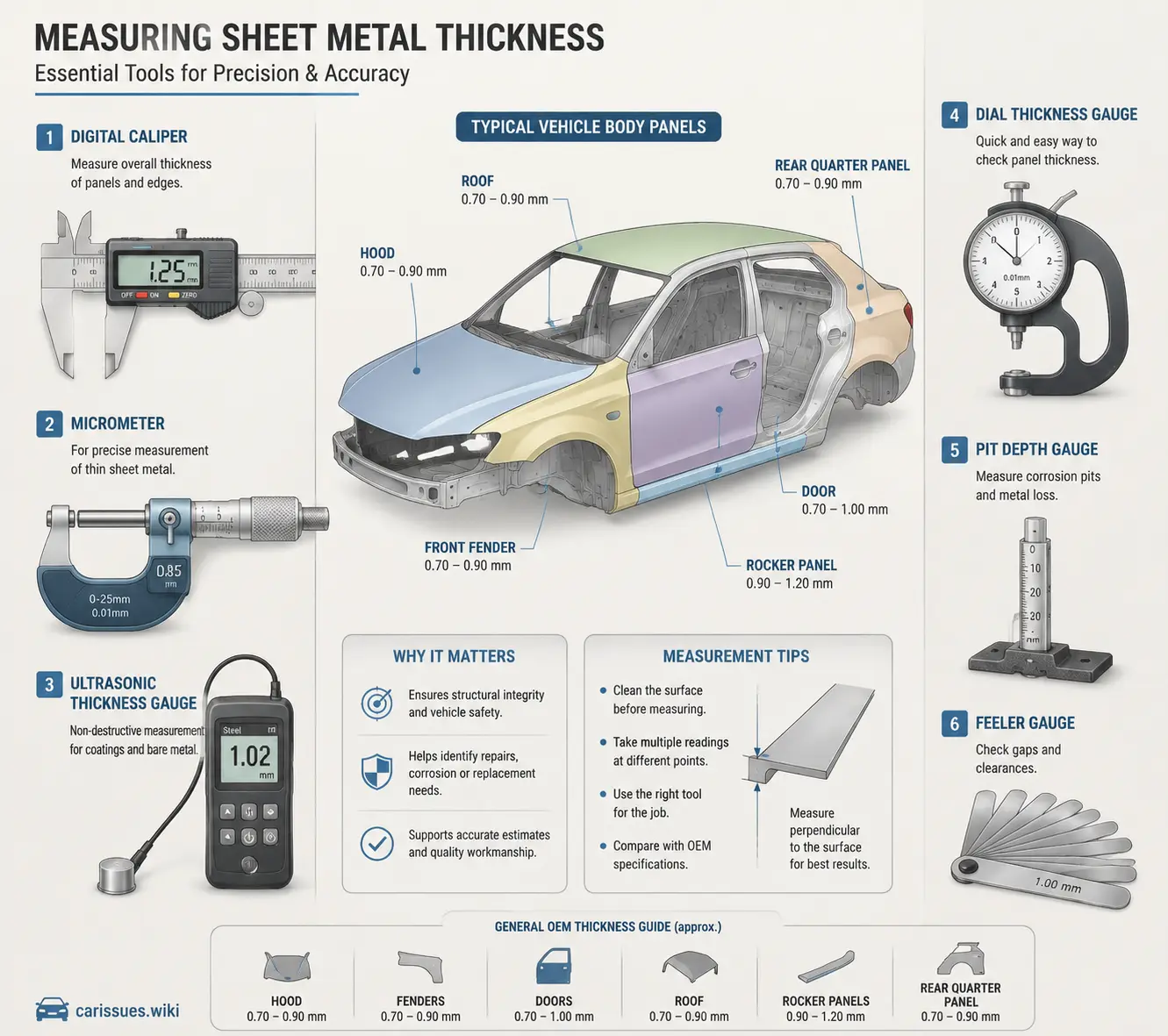
Accurately measuring automotive sheet metal matters tremendously during repairs, restorations, and custom fabrication. Using the wrong thickness can create welding issues, panel distortion, poor fitment, and even compromised safety. Professionals therefore rely on precise measurement tools rather than visual guesses.
One common tool is the sheet metal gauge gauge, which quickly identifies approximate gauge thickness. Micrometers and calipers provide more accurate readings in millimeters or inches. Many body shops prefer metric measurements because they eliminate confusion between different gauge standards. According to fabrication references, gauge systems vary between steel, aluminum, stainless steel, and galvanized materials.
Paint thickness can also complicate measurements. Corrosion, coatings, and repairs may slightly alter readings. Skilled technicians therefore measure exposed edges whenever possible. Matching original thickness is especially critical for structural repairs because welding heat and load distribution depend heavily on material specifications.
Modern repair manuals often specify exact OEM metal thicknesses for different vehicle zones. That precision reflects how sophisticated automotive engineering has become. Two panels that look nearly identical externally may behave very differently during a collision because of alloy composition, heat treatment, or reinforcement design.
Tools Used by Professionals
Common measurement tools include:
- Digital calipers
- Micrometers
- Sheet metal gauge tools
- Ultrasonic thickness gauges
- OEM repair specification charts
Each tool serves a specific role depending on accessibility and precision requirements.
Gauge Charts Versus Millimeter Measurements
Gauge numbers are convenient shorthand, but millimeter measurements provide greater precision and consistency across materials.
Modern Manufacturing Trends Toward Lighter Materials
The automotive industry is moving aggressively toward lightweight construction. Fuel economy regulations, emissions targets, and electric vehicle efficiency demands have pushed manufacturers to rethink traditional steel-heavy designs. That shift has transformed the way sheet metal thickness is approached today.
Advanced high-strength steel has become one of the industry’s favorite solutions. AHSS allows thinner sections to deliver superior structural performance compared to older mild steel. Engineers can reduce panel thickness while maintaining crash protection, torsional rigidity, and durability. Some modern ultra-high-strength steels are so strong that they require specialized repair techniques and equipment.
Aluminum has also expanded rapidly, especially in trucks, luxury vehicles, and EVs. Aluminum weighs significantly less than steel, which helps offset battery mass and improve efficiency. Because aluminum behaves differently structurally, manufacturers often use slightly thicker aluminum panels to compensate for lower stiffness. Industry references show aluminum automotive panels commonly ranging between 14 and 18 gauge equivalents.
Mixed-material construction is becoming increasingly common as well. A single vehicle may combine steel, aluminum, magnesium, carbon fiber composites, and adhesives within one structure. That approach allows engineers to optimize each area individually. Structural zones receive ultra-strong materials while less critical areas prioritize weight savings.
Advanced High-Strength Steel
AHSS enables thinner panels with greater structural performance. This technology plays a major role in modern crash safety and efficiency improvements.
Aluminum and Mixed-Material Designs
Manufacturers increasingly combine multiple materials to optimize strength, weight, corrosion resistance, and manufacturing costs.
Repairs That Depend on Matching the Correct Gauge
Automotive repairs are not just about making a damaged panel look straight again. Proper restoration requires matching the original material thickness and structural characteristics as closely as possible. Using incorrect gauge metal can compromise safety, durability, and corrosion resistance.
Collision repair professionals pay close attention to OEM specifications because welding behavior changes with thickness. Thin sheet metal overheats quickly and may warp under excessive heat input. Structural high-strength steels require controlled welding procedures to maintain their engineered properties. Using thicker metal than specified might sound safer, but it can alter crash energy distribution in dangerous ways.
Imagine replacing part of a crumple zone using overly thick steel. During a future collision, that section may fail to deform correctly. Instead of absorbing energy progressively, it could redirect forces toward passengers or adjacent structures. Automotive crash engineering depends heavily on predictable deformation patterns.
Restoration work on classic vehicles introduces another challenge. Older cars often used thicker mild steel than modern vehicles. Replacement panels must therefore match the original construction style while still considering modern repair practices. Skilled fabricators frequently use English wheels, planishing hammers, and shrinker-stretchers to recreate factory contours accurately.
Welding and Structural Integrity
Correct gauge selection ensures proper weld penetration, heat management, and structural behavior after repairs.
Problems Caused by Incorrect Thickness
Improper thickness can lead to warping, poor crash performance, misaligned panels, excessive weight, and premature corrosion.
What Thicker Metal Does Not Always Mean
Many drivers still associate heavy vehicles and thick steel with superior safety. That belief comes from older automotive eras when cars relied heavily on mass and rigidity. Modern engineering has proven that smart structural design matters far more than raw thickness alone.
A thick, rigid body can actually transfer more crash energy directly into occupants. Modern vehicles instead use controlled crumpling to absorb energy progressively. Think about how a bicycle helmet cracks during an impact. The visible damage means it successfully dissipated force. Cars operate under a similar principle.
This is why some modern vehicles appear heavily damaged after crashes while occupants walk away safely. Exterior destruction often indicates that crumple zones performed exactly as intended. Meanwhile, the passenger survival cell remains intact. Engineers carefully tune thickness, reinforcement placement, and material composition to achieve this balance.
Thicker metal also introduces penalties. Excessive weight hurts fuel economy, acceleration, braking, and handling. Electric vehicles suffer reduced range when unnecessary mass is added. Manufacturing costs rise as well. Automakers therefore aim for efficiency, not brute force. The best modern vehicles achieve impressive safety ratings using intelligent material distribution rather than simply adding thicker steel everywhere.
The Myth of Heavy Cars Being Safer
Vehicle mass can influence collisions, but intelligent engineering, restraint systems, and structural integrity matter far more than raw weight.
Smart Engineering Beats Raw Thickness
Modern safety comes from advanced materials, energy management, reinforcement strategies, and computer-designed crash structures.
Conclusion
Automotive sheet metal thickness is far more sophisticated than most drivers realize. Modern cars use a carefully engineered combination of thin exterior panels, reinforced structural zones, advanced high-strength steel, aluminum, and mixed-material construction to balance safety, efficiency, durability, and cost. Exterior body panels commonly range between 20 and 22 gauge, while structural components may use much thicker high-strength materials depending on the vehicle’s design.
What truly matters is not simply how thick the metal feels when you tap on a door or lean against a fender. Real automotive safety depends on structural engineering, crash energy management, and intelligent material placement. Modern manufacturing trends continue pushing vehicles toward lighter, stronger, and more efficient designs. Whether you are repairing collision damage, restoring a classic car, or simply curious about modern engineering, understanding automotive sheet metal thickness offers a fascinating glimpse into how vehicles are designed to protect both performance and passengers.
FAQs
1. What gauge steel is commonly used for car body panels?
Most modern car body panels use between 20 and 22 gauge steel, which equals roughly 0.65 mm to 0.88 mm thick depending on the material and manufacturer.
2. Are modern cars made with thinner metal than older cars?
Yes, many modern vehicles use thinner exterior panels compared to older cars. However, advanced high-strength steel and improved structural engineering make modern vehicles significantly safer overall.
3. Does thicker car metal mean better crash protection?
Not necessarily. Crash safety depends more on structural design, crumple zones, and energy absorption than simple metal thickness alone.
4. How do professionals measure automotive sheet metal thickness?
Technicians typically use digital calipers, micrometers, gauge tools, and OEM repair specifications to measure and verify thickness accurately.
5. Why do electric vehicles use lightweight materials?
Electric vehicles already carry heavy battery packs. Lightweight materials help offset battery weight, improve driving range, and maintain handling performance.