
A spare tire is one of those things most drivers forget exists; until the exact moment they desperately need it. Picture this: you’re driving home late at night, the road is empty, and suddenly you hear that unmistakable thump-thump-thump of a flat tire. You pull over, open the trunk, and discover your spare tire is nearly flat too. That tiny oversight instantly turns a manageable inconvenience into a stressful roadside nightmare.
The truth is, spare tire pressure matters far more than most people realize. Unlike regular tires that get checked often because they’re visible every day, spare tires sit hidden away for months or even years. During that time, they naturally lose air pressure. Many compact “donut” spares also require much higher PSI than normal tires, which surprises many drivers the first time they read the label.
According to the , poor tire maintenance contributes to hundreds of fatal crashes every year, and underinflation remains one of the biggest problems drivers face.
Before you trust your spare tire in an emergency, you need to understand how much air it should contain, why spare tires use different pressure levels, how temperature affects PSI, and when a spare tire should be replaced. This guide covers every important detail so you never get caught off guard on the side of the road.
Why Spare Tire Pressure Matters More Than Most Drivers Think
Most people treat a spare tire like a fire extinguisher. It sits untouched in the trunk for years, quietly collecting dust while everyone assumes it will magically work when needed. That assumption causes countless roadside problems every single year. A spare tire is not just a backup accessory; it is an emergency safety device. If it fails, your ability to safely control the vehicle disappears instantly.
The major issue is that tires naturally lose air over time, even when they are not being used. According to tire safety guidance from the , drivers should check all tires, including the spare, at least once a month. Yet many vehicle owners go years without inspecting the spare tire at all. That’s like storing a flashlight with dead batteries and expecting it to save you during a blackout.
A properly inflated spare tire provides stability, supports the vehicle’s weight correctly, and reduces the risk of dangerous heat buildup while driving. Underinflated tires flex too much under pressure, which creates friction and excess heat. Over time, this can lead to sidewall damage or even tire failure. Compact spares are especially vulnerable because they are smaller and designed for temporary emergency use only.
Drivers often assume all tires should have the same PSI, but spare tires operate under completely different rules. Temporary donut spares usually need much higher pressure than regular tires. Ignoring that difference can make the vehicle unstable and unsafe during emergency driving situations.
The Hidden Risks of Ignoring Spare Tire Maintenance
One of the biggest misconceptions about spare tires is that “unused” means “like new.” Rubber ages regardless of mileage. Heat, humidity, temperature swings, and oxygen slowly break down the tire structure over time. Even a spare tire that has never touched the road can become dangerous after several years.
Recent automotive safety discussions note that most spare tires have a lifespan of around six to ten years, even when unused. Cracks in the rubber, dry rot, sidewall bulges, or tread separation are all warning signs that the tire is no longer reliable. Imagine relying on a parachute packed a decade ago and never inspected; that’s essentially what an old neglected spare tire becomes.
Many modern vehicles no longer include full-size spare tires. Instead, they use lightweight compact spares designed only for short distances and lower speeds. That makes regular maintenance even more important because these smaller tires operate closer to their design limits. If the pressure is even slightly low, performance drops dramatically.
A spare tire should never be viewed as a “set it and forget it” component. It deserves the same attention as the four tires currently touching the road.
Related Articles: How to Reset Ford Tire Pressure Monitor System
How Much Air Should Be in a Spare Tire
The correct amount of air in a spare tire depends entirely on the type of spare tire your vehicle uses. There is no universal PSI number that works for every car, truck, or SUV. Full-size spare tires generally use pressures similar to standard road tires, while compact temporary spares often require significantly higher PSI levels.
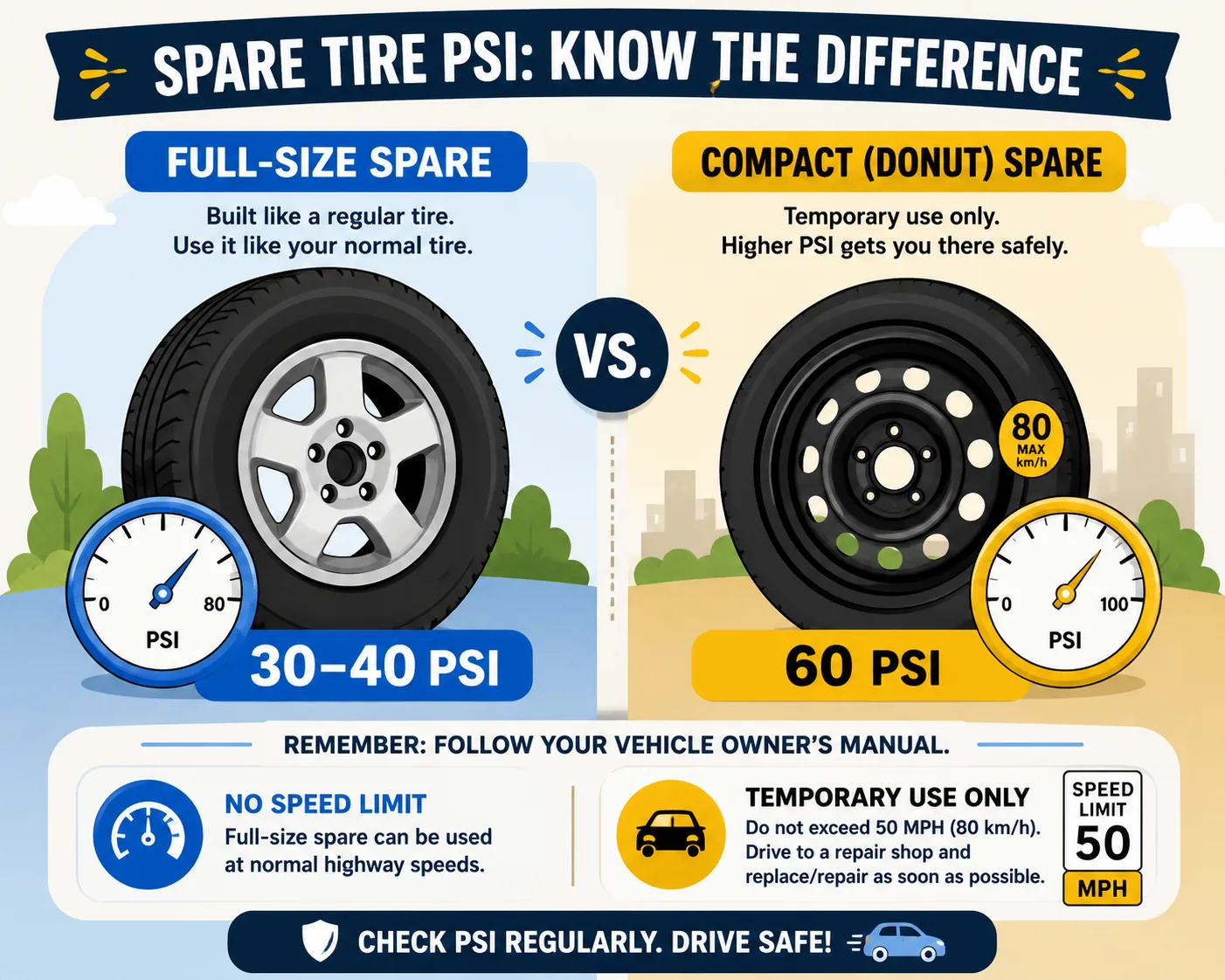
Most regular passenger vehicle tires operate somewhere between 30 and 40 PSI. Full-size spare tires usually stay within that same range because they are designed to match the vehicle’s standard tires. Compact donut spares are very different. These smaller emergency tires commonly require around 60 PSI to safely support the vehicle’s weight.
The difference surprises many drivers. Seeing “60 PSI” printed on a spare tire can feel alarming if you are used to normal tires running near 35 PSI. But compact spares are intentionally engineered for higher pressure because they have less air volume and a smaller footprint on the road.
Typical PSI for Full-Size Spare Tires
A full-size spare tire is essentially identical to the regular tires already mounted on the vehicle. Because it matches the original tire size, tread width, and load capacity, it usually operates at the same recommended PSI as the primary tires.
For many passenger cars, that means somewhere around 32 to 38 PSI, though the exact number varies depending on the manufacturer. Trucks and SUVs may require higher pressures, especially if they carry heavy loads or use reinforced tires.
The safest approach is to check the vehicle’s tire placard located on the driver’s door jamb. Never rely solely on the maximum PSI listed on the tire sidewall. The maximum number represents the tire’s upper pressure limit, not the recommended operating pressure.
Typical PSI for Compact Donut Spare Tires
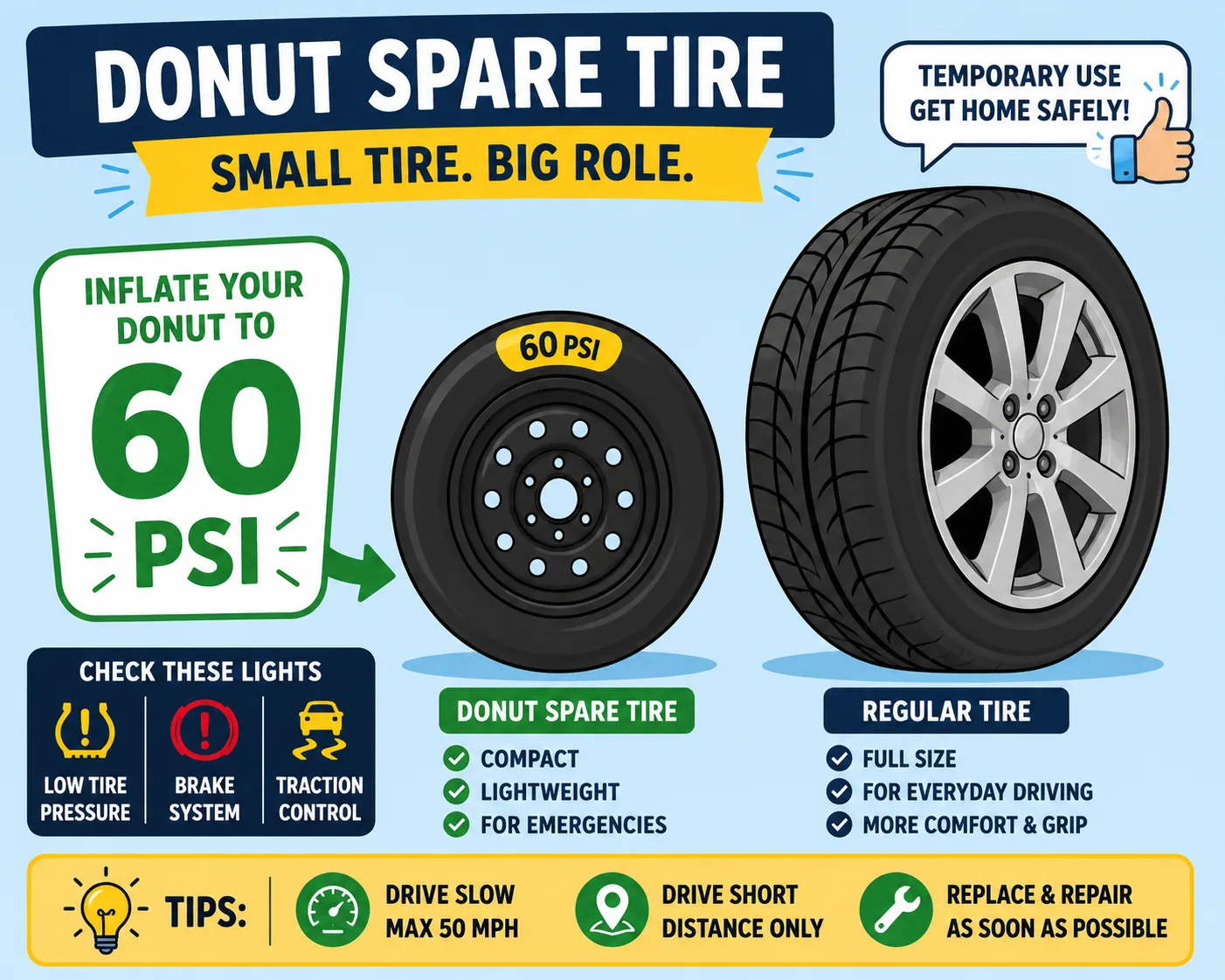
Compact temporary spare tires, commonly called donut spares, usually require approximately 60 PSI. These tires are much smaller than standard tires, so the increased air pressure helps compensate for reduced size and lower air volume.
Think of it like blowing up a small balloon very tightly to support weight. The tire needs extra internal pressure to maintain shape and support the vehicle properly. Without sufficient PSI, the smaller tire flexes excessively and overheats rapidly.
Because these tires lose pressure naturally over time, mechanics often recommend checking them several times per year even if the vehicle is rarely driven.
Why Spare Tires Need Different Pressure Levels
Spare tires are engineered differently from standard tires, especially compact temporary spares. Their unusual appearance is not just about saving trunk space; it directly affects how they carry weight and handle road stress.
A compact spare tire has a narrower tread, smaller diameter, and lower air volume compared to a normal tire. To compensate for these limitations, manufacturers increase the required PSI dramatically. Higher pressure stiffens the tire structure and improves its ability to support the vehicle during temporary use.
Without that added pressure, the tire would flatten too much under load. Excessive flexing generates dangerous heat inside the tire casing, increasing the likelihood of sudden failure. This is why most donut spares specifically warn drivers not to operate them below the recommended PSI.
The Engineering Behind High-Pressure Compact Spares
Imagine trying to support a heavy object using a small air cushion instead of a large one. The smaller cushion needs much greater pressure to carry the same weight. That is essentially how compact spare tires function.
According to automotive engineering explanations, compact spare tires usually operate near 60 PSI because the smaller contact patch requires denser air pressure to maintain stability. This design allows automakers to reduce vehicle weight and free up trunk space without eliminating emergency tire capability entirely.
The tradeoff is reduced durability and limited performance. Compact spares are never intended for extended driving. They are temporary solutions meant to get you safely to a repair facility; not replacements for full driving conditions.
The Recommended PSI for Full-Size and Compact Spares
Understanding the difference between full-size and temporary spares helps drivers avoid dangerous mistakes. The wrong PSI setting can completely change how the vehicle handles, brakes, and responds during emergency driving situations.
Comparing Full-Size and Temporary Spare Tires
| Spare Tire Type | Typical PSI Range | Speed Limit | Intended Usage |
|---|---|---|---|
| Full-Size Spare | 30–40 PSI | Normal driving speeds | Can often be used longer-term |
| Compact Donut Spare | Around 60 PSI | Usually under 50 MPH | Temporary emergency use only |
| Space-Saver Spare | 35–60 PSI | Under 50 MPH | Short-distance emergency driving |
Experts commonly recommend keeping compact spares inflated at their full specified pressure at all times because they naturally lose air over long storage periods. Waiting until a flat tire occurs before inflating the spare is risky because compressors can fail, batteries can die, and roadside conditions may be unsafe.
PSI Comparison Table
Drivers should always remember that recommended PSI and maximum PSI are completely different numbers. The recommended PSI comes from the vehicle manufacturer and reflects ideal handling, comfort, and safety characteristics. The maximum PSI printed on the tire sidewall only represents the tire’s pressure limit under maximum load conditions.
Using the wrong pressure can lead to uneven wear, poor handling, and reduced traction. Underinflation wears the edges of the tire rapidly, while overinflation can wear the center tread prematurely.
Where to Find the Correct Tire Pressure Information
One of the easiest ways to avoid spare tire mistakes is knowing exactly where to locate the correct PSI information. Fortunately, vehicle manufacturers provide this information in several locations.
Driver’s Door Placard
The most reliable source is the tire information placard inside the driver’s side door jamb. This label typically lists the correct pressure for front tires, rear tires, and the spare tire separately.
The specifically recommend using the door placard instead of relying on the tire sidewall. Many drivers make the mistake of inflating tires based on the sidewall maximum PSI, which can create unsafe handling conditions.
Owner’s Manual
The owner’s manual also contains detailed information about spare tire inflation, speed limitations, and driving restrictions. Some vehicles include different pressure recommendations depending on passenger load or towing conditions.
Modern manuals often explain whether the vehicle uses a full-size spare, compact spare, run-flat system, or sealant kit.
Tire Sidewall Information
Compact spare tires usually display critical warnings directly on the sidewall, including maximum speed limits and inflation requirements. You might see warnings such as:
- “Temporary Use Only”
- “Maximum Speed 50 MPH”
- “Inflate to 60 PSI”
Ignoring these warnings can turn a simple flat tire into a dangerous blowout situation.
How Temperature Changes Affect Spare Tire Pressure
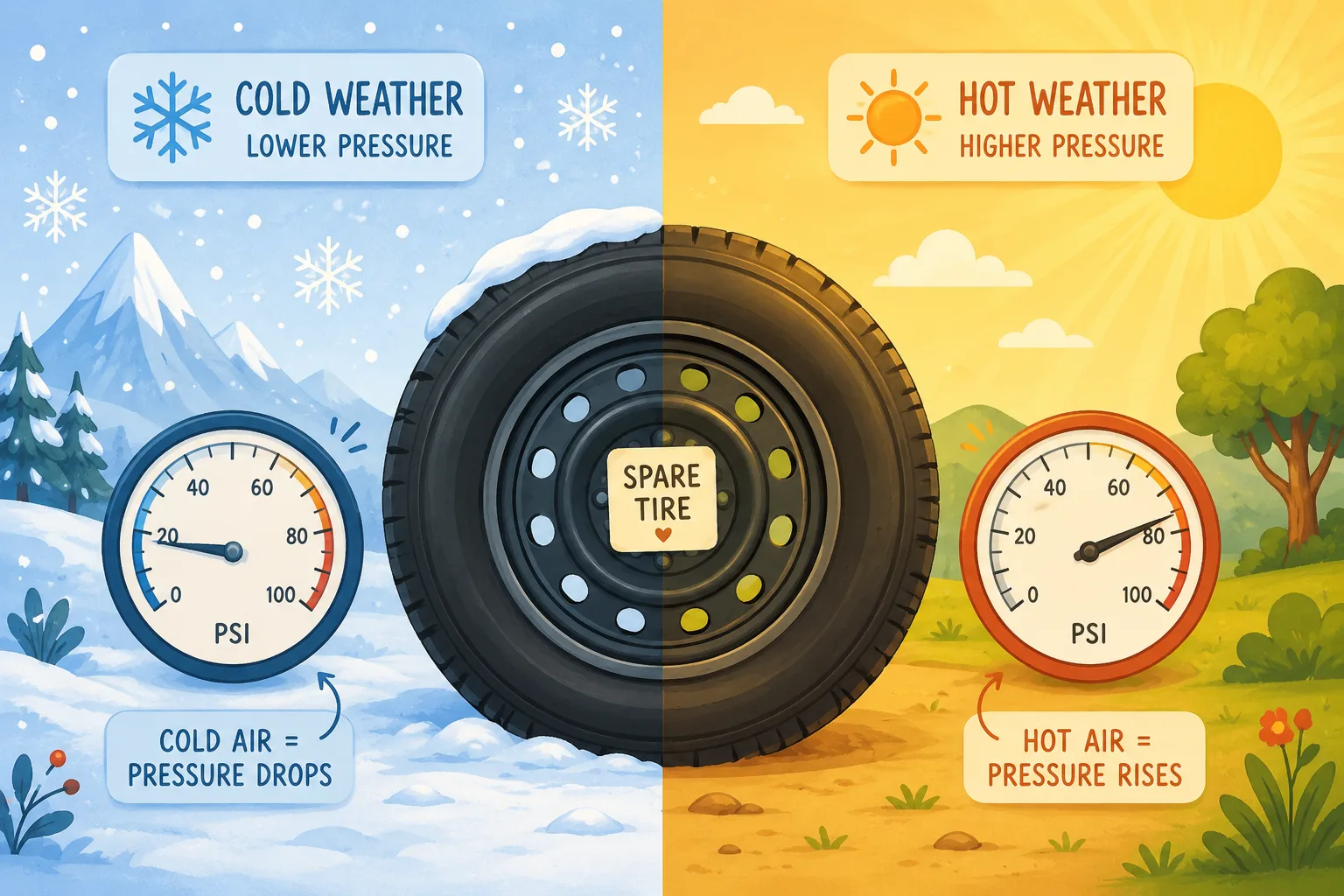
Temperature dramatically affects tire pressure, including spare tires hidden in the trunk. Air expands when heated and contracts when cooled, meaning PSI levels constantly fluctuate with weather conditions.
Cold Weather Pressure Loss
During colder months, tire pressure naturally drops. A common rule of thumb is that tires lose roughly 1 PSI for every 10-degree Fahrenheit temperature decrease. That means a spare tire sitting unused through winter can easily become dangerously underinflated without anyone noticing.
This matters even more for compact spares because they already operate at high pressure levels. Losing 8–10 PSI from a 60 PSI spare creates a significant performance problem.
Drivers in colder climates should check spare tire pressure more frequently during seasonal temperature swings.
Read More: How Cold Is Too Cold for Car Wash
Hot Weather Pressure Expansion
Hot weather causes tire pressure to rise temporarily. That increase is normal, but drivers should still inflate tires based on “cold” readings before driving.
Heat buildup becomes especially dangerous when a compact spare is underinflated. The sidewalls flex excessively, friction increases, and internal temperatures can rise rapidly. That combination can destroy the tire within surprisingly short distances.
Think of underinflation like jogging in shoes that are too soft and unstable. Every step creates more strain and heat until failure becomes inevitable.
What Happens if a Spare Tire Is Underinflated
Driving on an underinflated spare tire is extremely risky. The vehicle becomes less stable, braking distances increase, steering response weakens, and heat buildup accelerates.
Reduced Stability and Increased Heat
Underinflated tires flatten more where they contact the road. While that may sound harmless, it creates excessive sidewall flexing and friction. The more the tire flexes, the hotter it becomes.
Heat is the enemy of tire safety. Excessive heat weakens internal tire structures and increases the risk of sudden failure. Compact spares are especially vulnerable because they already operate near their design limits.
According to tire maintenance experts, underinflation can also reduce fuel efficiency, shorten tire lifespan, and compromise traction during wet conditions.
An underinflated spare tire also handles unpredictably during emergency maneuvers. Sudden lane changes or hard braking can destabilize the vehicle far more easily compared to a properly inflated tire.
The Risk of Driving Too Fast on a Spare
Speed restrictions on spare tires are not arbitrary legal warnings; they are based on engineering limitations. Compact spare tires are built for temporary use, not highway-speed travel over long distances.
Understanding the 50 MPH Rule
Most compact spare tires carry a maximum speed recommendation of around 50 MPH. Some manufacturers may specify slightly different limits, but the principle remains the same: slow driving reduces heat buildup and stress on the smaller tire.
Driving too fast on a donut spare increases the risk of:
- Tire overheating
- Blowouts
- Poor braking performance
- Reduced traction
- Loss of steering stability
Imagine sprinting in flip-flops instead of running shoes. You might manage briefly, but the equipment is not designed for that level of performance. Compact spares work the same way.
Most experts also recommend limiting travel distance to around 50–70 miles before replacing or repairing the damaged tire. These spares are emergency tools; not permanent substitutes.
How Often to Check the Spare Tire Condition
Checking the spare tire should become part of routine vehicle maintenance, not an afterthought reserved for emergencies.
Monthly and Seasonal Inspection Tips
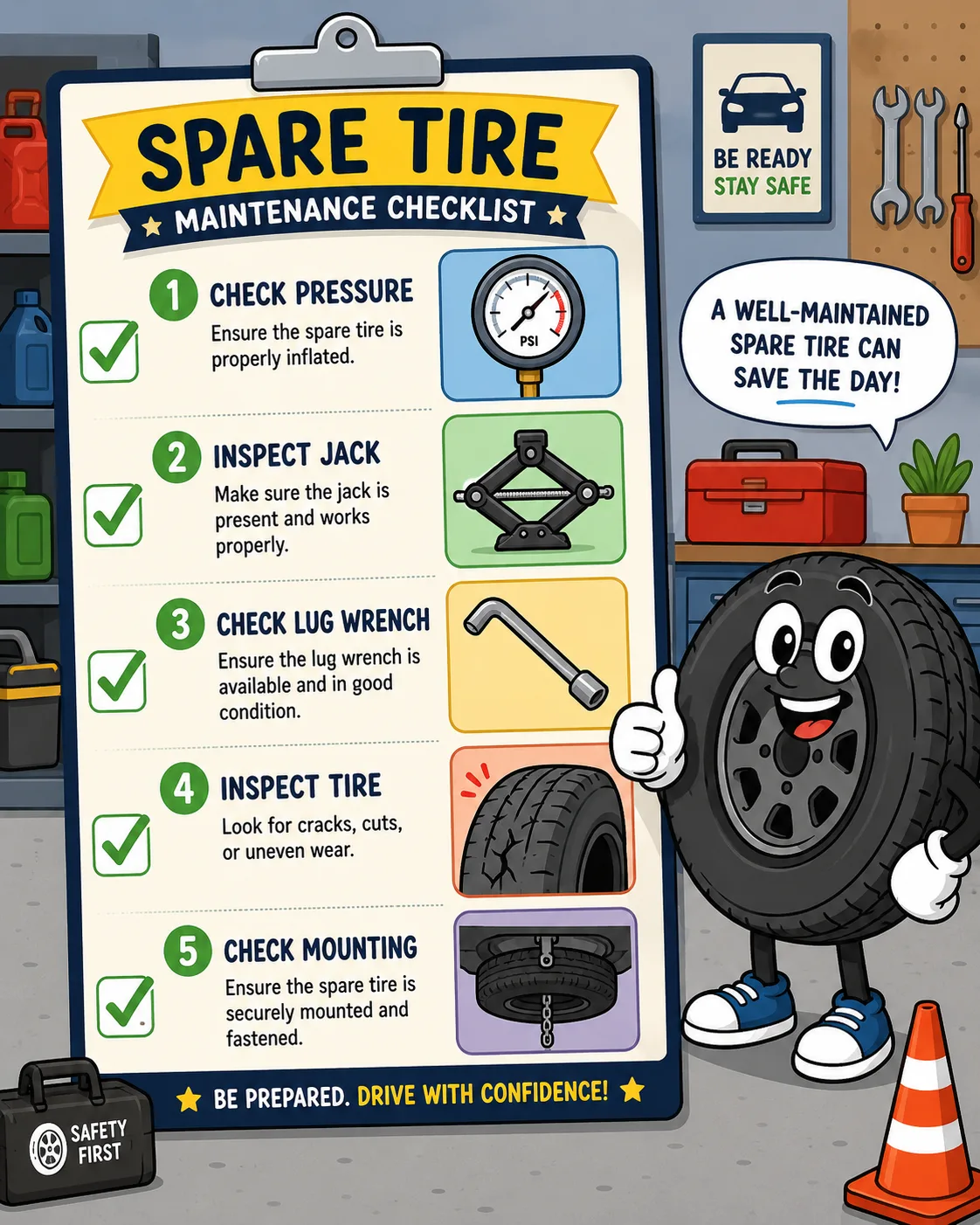
The advise checking all tires, including the spare, at least once per month. That includes verifying PSI, inspecting for visible damage, and ensuring the tire holds pressure properly.
A good inspection routine includes:
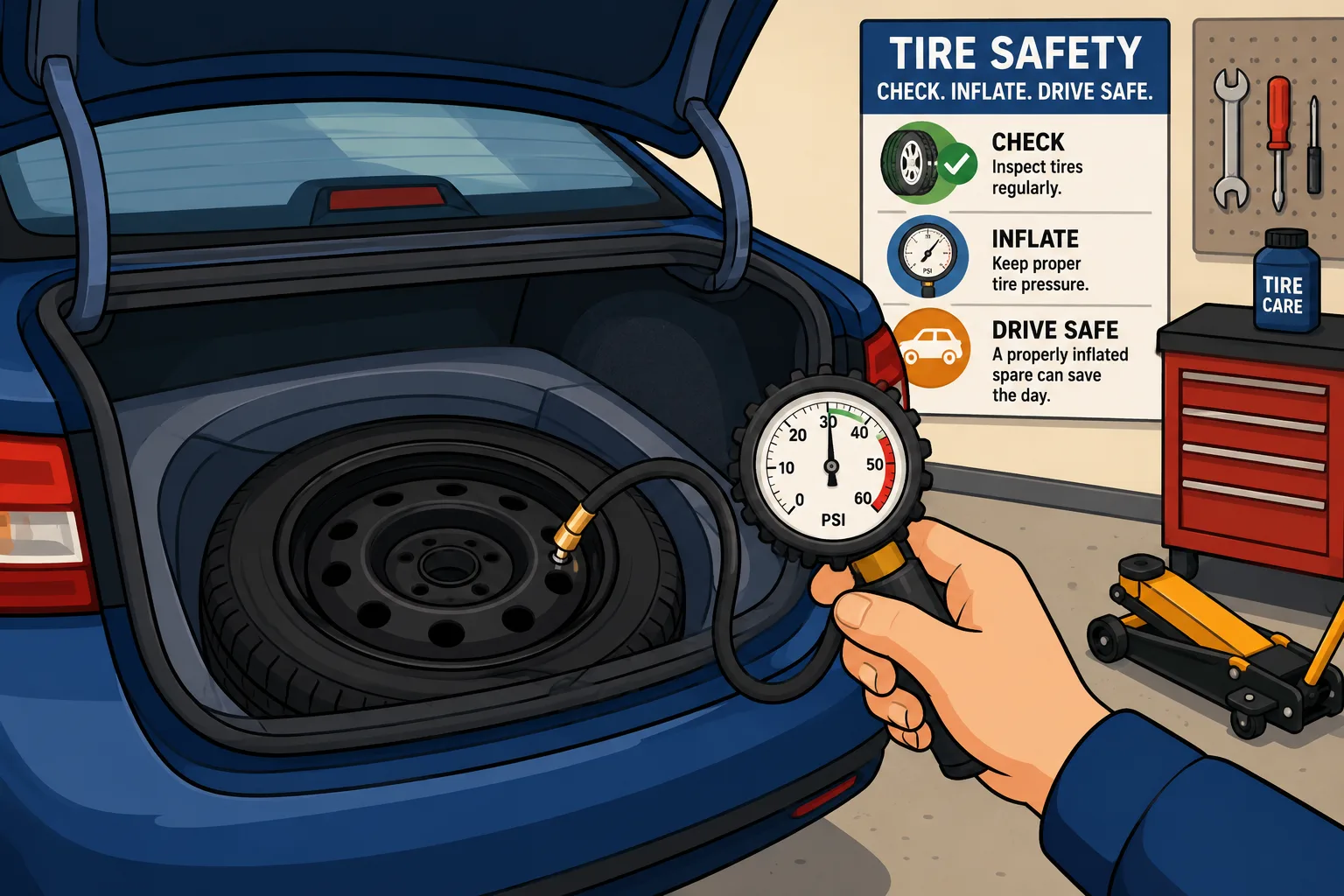
- Checking tire pressure with a quality gauge
- Inspecting sidewalls for cracks or bulges
- Looking for dry rot or uneven wear
- Confirming the jack and lug wrench are present
- Verifying the tire is securely mounted
Many automotive experts also recommend checking the spare before long road trips. There is nothing worse than discovering a dead spare tire hundreds of miles from home.
See Also: What Should a Fully Charged 12V Battery Read
Warning Signs That a Spare Tire Should Be Replaced
Even unused spare tires eventually expire. Rubber compounds degrade over time regardless of mileage.
Cracks, Dry Rot, and Aging Rubber
Recent tire safety discussions indicate most spare tires should be replaced after roughly six to ten years, even if unused. Exposure to heat, oxygen, moisture, and temperature fluctuations gradually weakens the tire structure.
Common warning signs include:
- Sidewall cracking
- Dry rot
- Bulges
- Uneven tread wear
- Loss of air pressure
- Visible cord exposure
- Tire age exceeding manufacturer recommendations
Drivers can determine tire age by reading the DOT code on the sidewall. The last four digits indicate the production week and year.
For example:
- “2523” means the tire was manufactured during the 25th week of 2023.
An old spare tire may look perfectly fine externally while suffering internal structural deterioration. That hidden weakness can cause sudden failure during emergency use.
Conclusion
A spare tire is one of the most overlooked safety components on any vehicle, yet it becomes critically important during emergencies. Understanding the correct PSI for your spare tire, maintaining proper inflation, and respecting speed limitations can mean the difference between safely reaching a repair shop and facing a dangerous roadside breakdown.
Full-size spares generally operate near the same pressure as regular tires, while compact donut spares commonly require around 60 PSI to compensate for their smaller size. Temperature changes, aging rubber, and natural air loss all affect spare tire reliability over time.
Drivers who regularly inspect their spare tire, monitor pressure levels, and replace aging rubber dramatically reduce their risk of emergency tire failure. The best time to discover a problem with your spare tire is in your driveway; not on a dark highway shoulder during a storm.
FAQs
1. How much air should a donut spare tire have?
Most compact donut spare tires require approximately 60 PSI, though the exact number depends on the vehicle manufacturer. Always check the driver’s door placard or owner’s manual for the correct specification.
2. Can I drive long distances on a spare tire?
Temporary compact spares are designed only for short emergency use. Most experts recommend limiting driving distance to around 50–70 miles and staying below 50 MPH.
3. How often should I check my spare tire pressure?
You should check spare tire pressure at least once per month and before long road trips. Spare tires naturally lose air over time, especially during seasonal temperature changes.
4. Why does my spare tire require more PSI than my regular tires?
Compact spare tires are smaller and contain less air volume. Higher pressure helps them safely support the vehicle’s weight and maintain stability during temporary emergency driving.
5. When should a spare tire be replaced?
Most spare tires should be replaced after six to ten years, even if unused. Signs such as cracking, dry rot, bulges, or air leaks also indicate replacement is necessary.

Marco Vestri is a 29-year-old American content writer based in Spokane, Washington. He specializes in creating well-researched automotive maintenance guides, troubleshooting articles, and practical ownership advice for everyday drivers. His work emphasizes accuracy, clear explanations, and reliable sources, helping readers make informed decisions with confidence. As a regular contributor to carissues.wiki, Marco combines years of blogging experience with a passion for simplifying complex vehicle topics into useful, trustworthy content for a broad audience.