
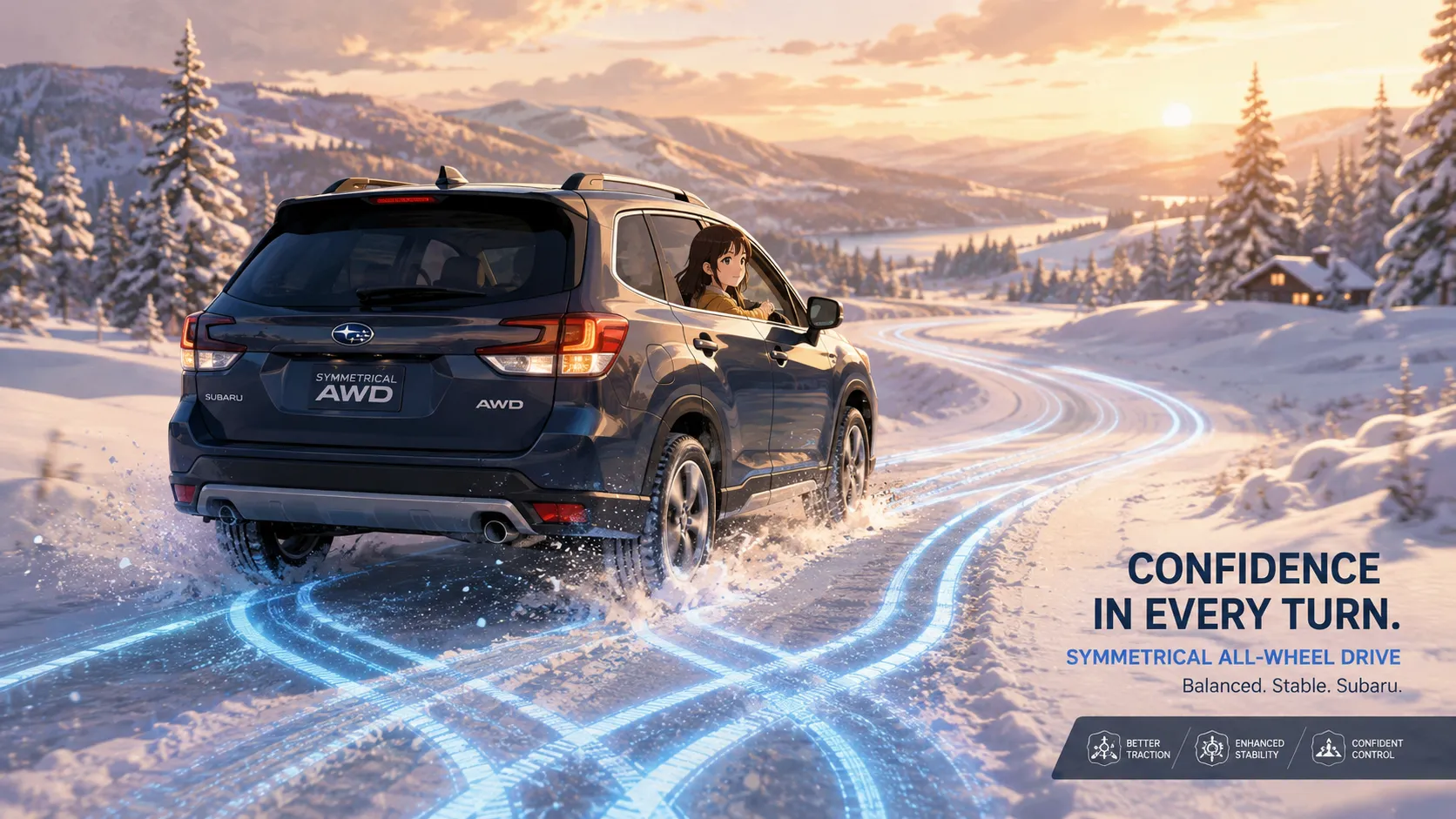
Winter driving feels a bit like walking across a frozen lake in regular sneakers. One moment everything seems stable, and the next moment you are sliding without warning. That is exactly why all wheel drive, commonly called AWD, has become such a popular feature in modern vehicles. Drivers often assume AWD is a magical solution that transforms any car into a snow beast capable of conquering icy roads without effort. The reality is more interesting; and more complicated.
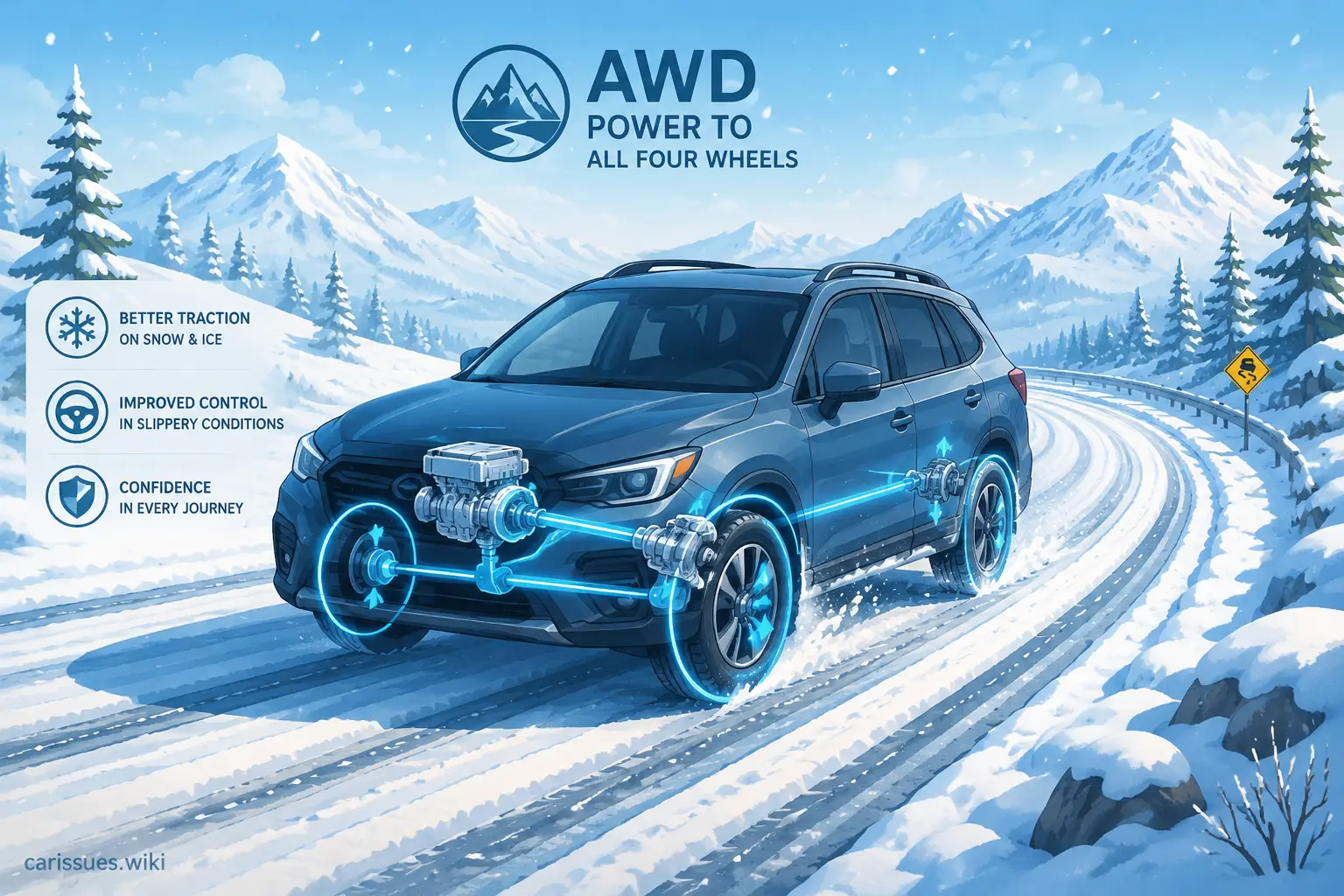
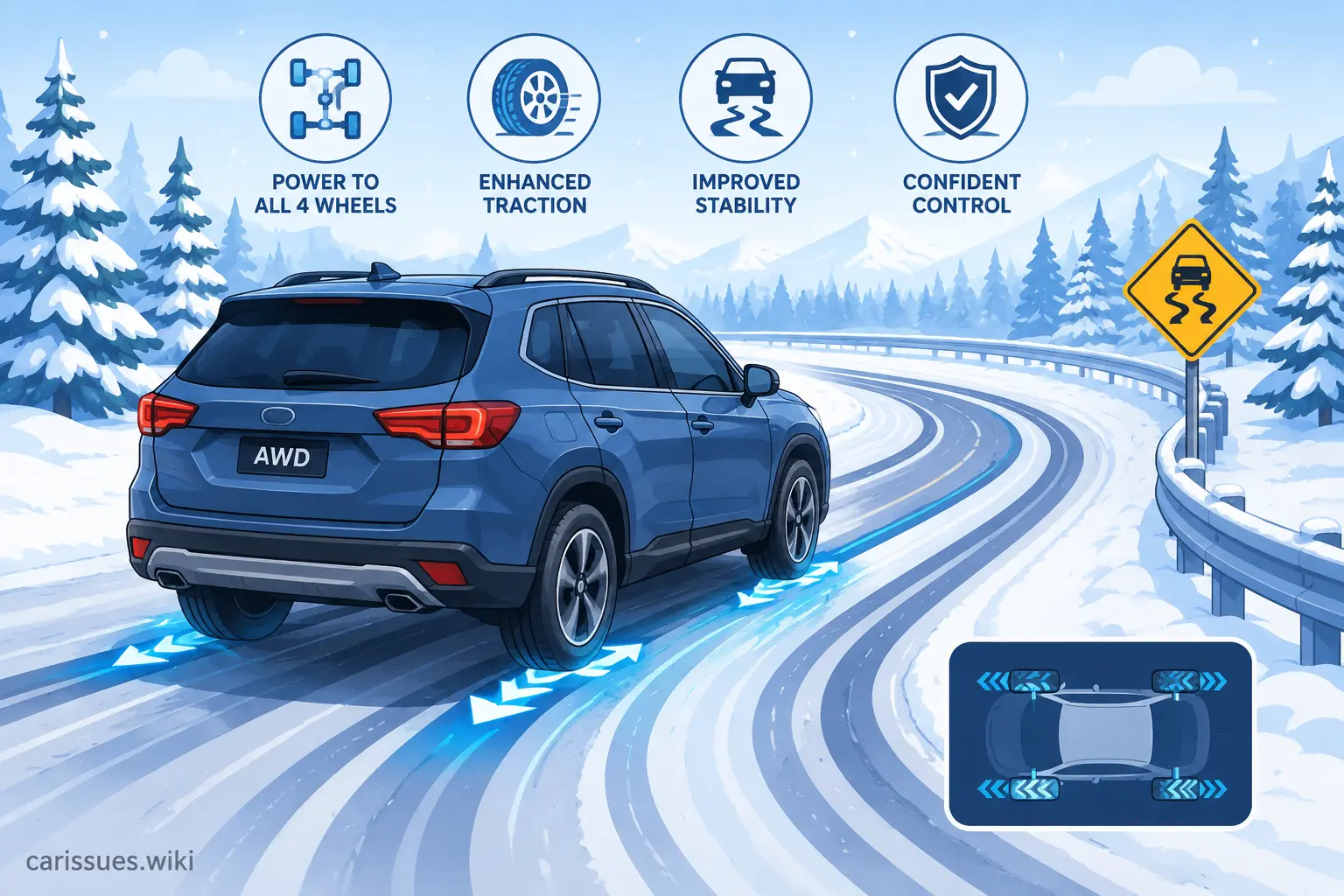
AWD works by distributing engine power to all four wheels instead of only the front or rear pair. On snowy roads, this extra traction can help vehicles move more confidently, especially during acceleration or when climbing hills. According to winter driving studies and crash data, AWD vehicles are often underrepresented in certain winter-condition crashes compared to two-wheel-drive vehicles, showing measurable traction advantages in snowy conditions. Still, AWD is not a force field against ice, snowbanks, or reckless driving habits.
Many drivers misunderstand what AWD actually does. They believe it improves every aspect of winter performance, including braking and cornering. In truth, AWD mainly helps vehicles get moving and maintain traction while accelerating. Tires, road conditions, and driver behavior still matter far more than the badge on the back of the vehicle. Think of AWD as hiking boots on a slippery trail. They help you grip the ground better, but they do not make you immune to falling if you run downhill too fast.
Understanding how AWD works in snow requires looking at how power moves through the drivetrain, how tires interact with frozen surfaces, and why modern AWD systems rely heavily on electronics and sensors. Once you understand these details, winter driving suddenly becomes less mysterious and much safer.
Understanding the Basics of AWD
What Happens When Roads Become Slippery
Snow and ice completely change the relationship between your tires and the road. On dry pavement, tires grip the surface through friction. When snow, slush, or ice cover the road, that friction drops dramatically. This reduction in grip makes it harder for the tires to transfer engine power effectively. That is why two-wheel-drive vehicles often struggle when accelerating uphill in winter weather.
In a front-wheel-drive vehicle, only the front tires receive engine power. In a rear-wheel-drive vehicle, only the rear tires push the car forward. If those powered wheels lose traction, the vehicle may spin, slide, or get stuck. AWD changes the equation by sending power to all four wheels. If one wheel slips, the system can redirect torque to wheels with better grip.
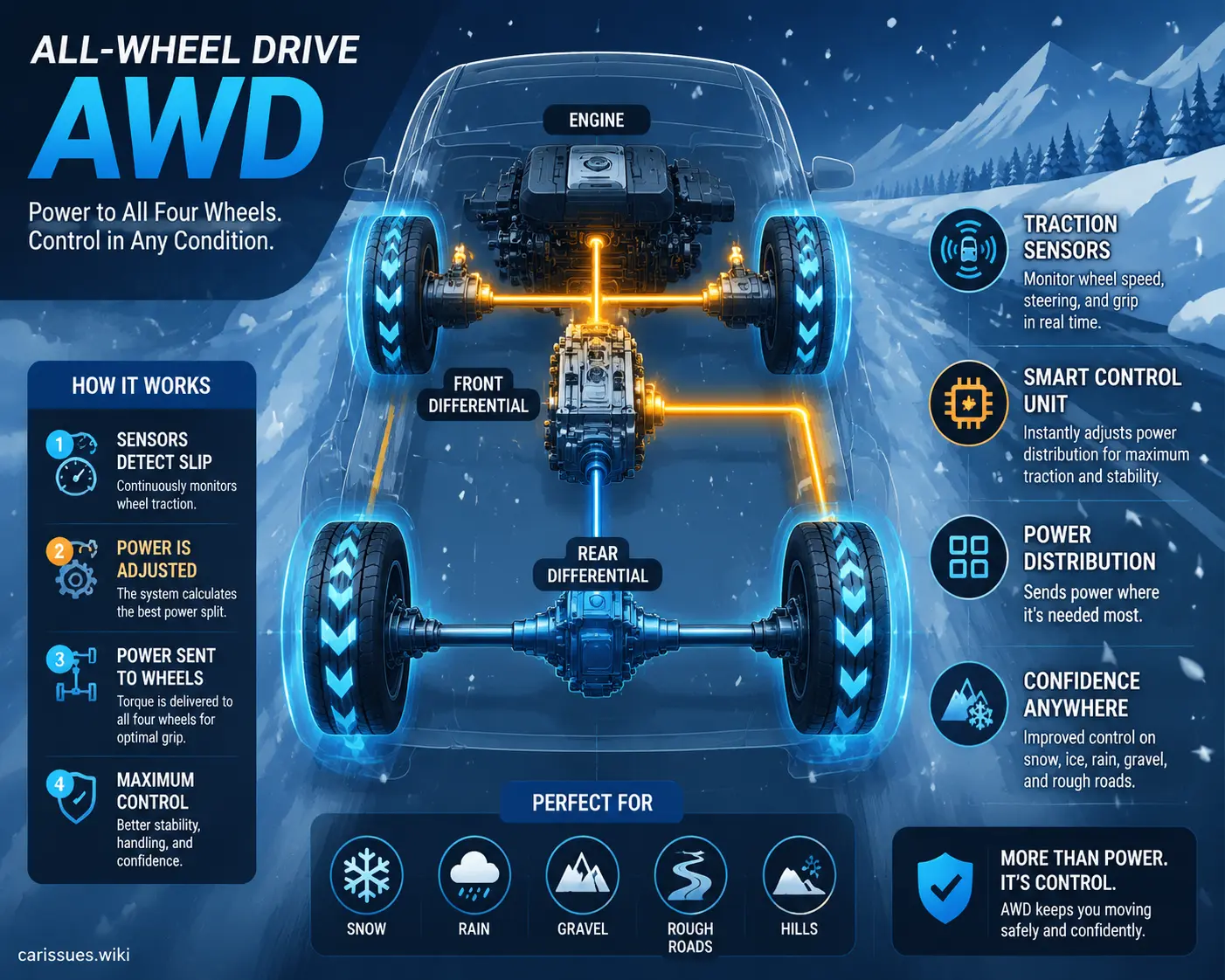
Modern AWD systems use computers, sensors, and electronic differentials to monitor traction constantly. The system checks wheel speed hundreds of times per second. If one tire starts spinning faster than the others, the vehicle instantly reacts by adjusting torque distribution. This rapid response helps maintain stability and forward momentum.
The experience for drivers is noticeable. Vehicles equipped with AWD typically accelerate more confidently on snowy roads and feel steadier during slippery conditions. That added confidence is one reason AWD has become so popular in SUVs, crossovers, and even sedans. Still, confidence can become dangerous when drivers overestimate what the technology can actually do.
How AWD Distributes Power Between Wheels
AWD systems are designed around one main goal: maximizing traction. The engine generates power, but the AWD system decides where that power goes. Unlike older mechanical four-wheel-drive systems that split power evenly, modern AWD systems dynamically adjust torque depending on road conditions.
Some AWD systems operate full-time, meaning all four wheels always receive power. Others operate automatically, sending most power to one axle until slip is detected. Once wheelspin occurs, the system redirects torque within milliseconds. This flexibility improves fuel efficiency while maintaining traction benefits.
Here is a simple comparison of drivetrain behavior in snow:
| Drivetrain | Power Delivery | Winter Traction |
|---|---|---|
| Front-Wheel Drive | Front wheels only | Moderate |
| Rear-Wheel Drive | Rear wheels only | Often weak |
| All-Wheel Drive | All four wheels | Strong acceleration grip |
| Four-Wheel Drive | Fixed power split | Best for off-road/deep snow |
Some advanced AWD systems also feature torque vectoring, which distributes power side-to-side between wheels. This improves cornering stability and reduces sliding during turns. Intelligent AWD systems can even predict wheel slip before it happens using steering angle sensors and throttle input analysis.
The result feels almost invisible to the driver. Instead of dramatic fishtailing or tire spinning, the vehicle quietly adjusts grip behind the scenes like a skilled orchestra conductor keeping every instrument in rhythm.
The Science Behind AWD Traction in Winter
Why Snow and Ice Reduce Tire Grip
Driving on snow is essentially driving on a constantly changing surface. Powder snow behaves differently from packed snow, slush, or black ice. Ice is especially dangerous because it dramatically lowers friction between the tires and the road. Even the best AWD system cannot create traction where none exists.
Temperature also affects tire performance. All-season tires become harder in freezing weather, reducing flexibility and grip. Winter tires use softer rubber compounds that remain pliable in cold conditions. That softness helps the tire bite into snow and maintain contact with icy pavement.
Research consistently shows that winter tires improve braking and turning far more effectively than AWD alone. Consumer Reports noted that less than 15% of surveyed AWD drivers used dedicated winter tires, despite the clear safety advantages they provide. That statistic highlights one of the biggest misconceptions in winter driving: many drivers rely on AWD while ignoring the importance of tires.
Imagine trying to sprint across a frozen basketball court wearing dress shoes. Now imagine wearing specialized cleats instead. The cleats represent winter tires. AWD simply determines how many legs are pushing you forward.
How Sensors and Differentials React to Wheel Slip
Modern AWD systems rely heavily on electronic systems. Wheel-speed sensors monitor rotation rates continuously. If one wheel spins faster than others, the vehicle assumes traction loss has occurred. The AWD controller then redirects power toward wheels with better grip.
Electronic stability control also plays a major role. If the vehicle begins sliding sideways, the system can reduce engine power or apply brakes to specific wheels. These adjustments help maintain directional control during slippery maneuvers.
Some systems are proactive while others are reactive. Reactive systems wait until wheel slip occurs before redistributing torque. Proactive systems predict traction loss based on throttle position, steering input, and road conditions. Premium brands often use predictive AWD technology because it creates smoother and faster responses.
The technology sounds impressive because it is impressive. Yet every system still depends on the same physical limitation: tire traction. If all four tires lose grip simultaneously on black ice, no AWD computer can magically stop the slide.
Different Types of AWD Systems
Full-Time AWD Systems
Full-time AWD continuously powers all four wheels. This design provides consistent traction and stability because torque is always distributed across both axles. Vehicles like certain luxury SUVs and rally-inspired performance cars commonly use this setup.
The advantage of full-time AWD becomes clear during rapidly changing road conditions. Drivers do not need to wait for wheel slip before the system reacts. Power is already distributed, helping maintain balance on slick surfaces.
Full-time AWD systems often include center differentials that allow front and rear wheels to rotate at different speeds. This improves handling while preventing drivetrain stress during turns. The tradeoff is increased fuel consumption because more drivetrain components are constantly active.
Drivers often describe full-time AWD vehicles as feeling planted and predictable in snow. That sense of stability can reduce stress during winter commutes and long highway drives.
Part-Time and Automatic AWD Systems
Automatic AWD systems are more common because they improve fuel economy. These systems primarily drive one axle under normal conditions. When slip is detected, power automatically transfers to the other axle.
This design works extremely well for everyday drivers because it balances efficiency and winter capability. Most drivers never even notice the transition happening. The system quietly manages traction in the background.
Part-time AWD systems differ slightly because some require manual engagement. These systems are more common in trucks and off-road-oriented vehicles. While highly effective in snow, they are less refined for daily road use.
The biggest advantage of automatic AWD lies in convenience. Drivers gain additional winter traction without constantly adjusting settings or driving modes.
Torque Vectoring and Intelligent AWD
Advanced AWD technology has evolved dramatically over the past decade. Torque-vectoring systems can independently control power delivery to individual wheels. Instead of merely shifting torque front-to-back, these systems fine-tune left-to-right distribution as well.
This capability improves cornering stability and helps reduce understeer or oversteer on icy roads. Performance-oriented AWD vehicles especially benefit from torque vectoring because it enhances both safety and handling precision.
Intelligent AWD systems also integrate artificial intelligence-like predictive logic. They analyze road conditions, throttle input, steering behavior, and braking patterns in real time. Some systems even disconnect certain drivetrain components temporarily to improve fuel efficiency.
Modern AWD technology feels almost like having an invisible co-driver constantly adjusting traction beneath you.
Why AWD Feels Safer in Snow
Better Acceleration on Snowy Roads
One of AWD’s greatest strengths is acceleration. When all four wheels receive power, the vehicle gains more opportunities to find traction. This becomes especially helpful during uphill climbs, merging into traffic, or starting from a stoplight on icy pavement.
Drivers notice fewer moments of wheelspin and less fishtailing. AWD vehicles can pull away more confidently than many front-wheel-drive or rear-wheel-drive models. That improved launch traction explains why AWD performs so well in snowy parking lots and unplowed roads.
According to crash analysis studies, AWD vehicles are often less involved in certain winter-condition crashes compared with comparable two-wheel-drive vehicles. Still, researchers also found evidence that overconfidence can offset some of these benefits if drivers begin traveling too fast for conditions.
That balance between capability and caution is crucial. AWD gives drivers more grip while accelerating, but it does not suspend the laws of physics.
Improved Stability During Cornering
AWD can also improve stability while turning, especially when paired with electronic stability control and torque vectoring systems. By distributing power strategically, AWD helps reduce the likelihood of losing control during slippery maneuvers.
On snow-covered roads, stability matters just as much as traction. Vehicles that maintain predictable handling are easier to control and less stressful to drive. AWD systems help reduce sudden fishtailing or uneven weight transfer during turns.
Still, cornering grip depends heavily on tire quality. A vehicle with winter tires often corners more effectively than an AWD vehicle using worn all-season tires. That reality surprises many drivers because marketing campaigns frequently exaggerate AWD’s capabilities.
The safest winter setup combines AWD with proper winter tires and cautious driving habits.
Situations Where AWD Still Struggles
Black Ice and Sudden Braking
Black ice is one of winter driving’s greatest dangers because it is nearly invisible. Even advanced AWD systems struggle on glare ice because traction drops close to zero.
AWD also does not improve braking distances. Every car already uses all four brakes when stopping. Tire grip; not drivetrain layout; determines how quickly a vehicle can stop. Multiple experts and winter driving studies emphasize this point repeatedly.
This misunderstanding leads many AWD drivers into trouble. They accelerate confidently on snowy roads, then discover too late that stopping remains extremely difficult. Swedish crash research even found higher impact speeds among AWD vehicles on icy roads, likely linked to overconfidence.
The lesson is simple: AWD helps you go, not stop.
Deep Snow and Ground Clearance Problems
AWD improves traction, but ground clearance matters too. A low sedan with AWD may still become stuck if snow piles underneath the chassis. Once the vehicle begins riding on packed snow instead of the tires, traction becomes almost irrelevant.
Deep snow also creates resistance that can overwhelm smaller vehicles. SUVs and crossovers typically perform better in these situations because they combine AWD with higher ride height.
Drivers living in regions with frequent blizzards often prefer vehicles with both AWD and substantial ground clearance. Even then, no vehicle is unstoppable in severe winter conditions.
Snow Tires Versus AWD
Why Tires Matter More Than Drivetrain
Tires are the only part of the vehicle that touches the road. That simple fact explains why winter tires matter more than AWD alone.
Winter tires use softer rubber compounds and aggressive tread patterns designed specifically for cold temperatures and snow evacuation. They improve braking, cornering, and acceleration simultaneously.
Experts consistently stress that winter tires outperform AWD when it comes to stopping and turning. A front-wheel-drive car equipped with quality winter tires often handles icy roads better than an AWD vehicle using ordinary all-season tires.
This comparison surprises many drivers because AWD receives far more marketing attention. Yet physics favors tire grip above all else.
The Best Combination for Winter Driving
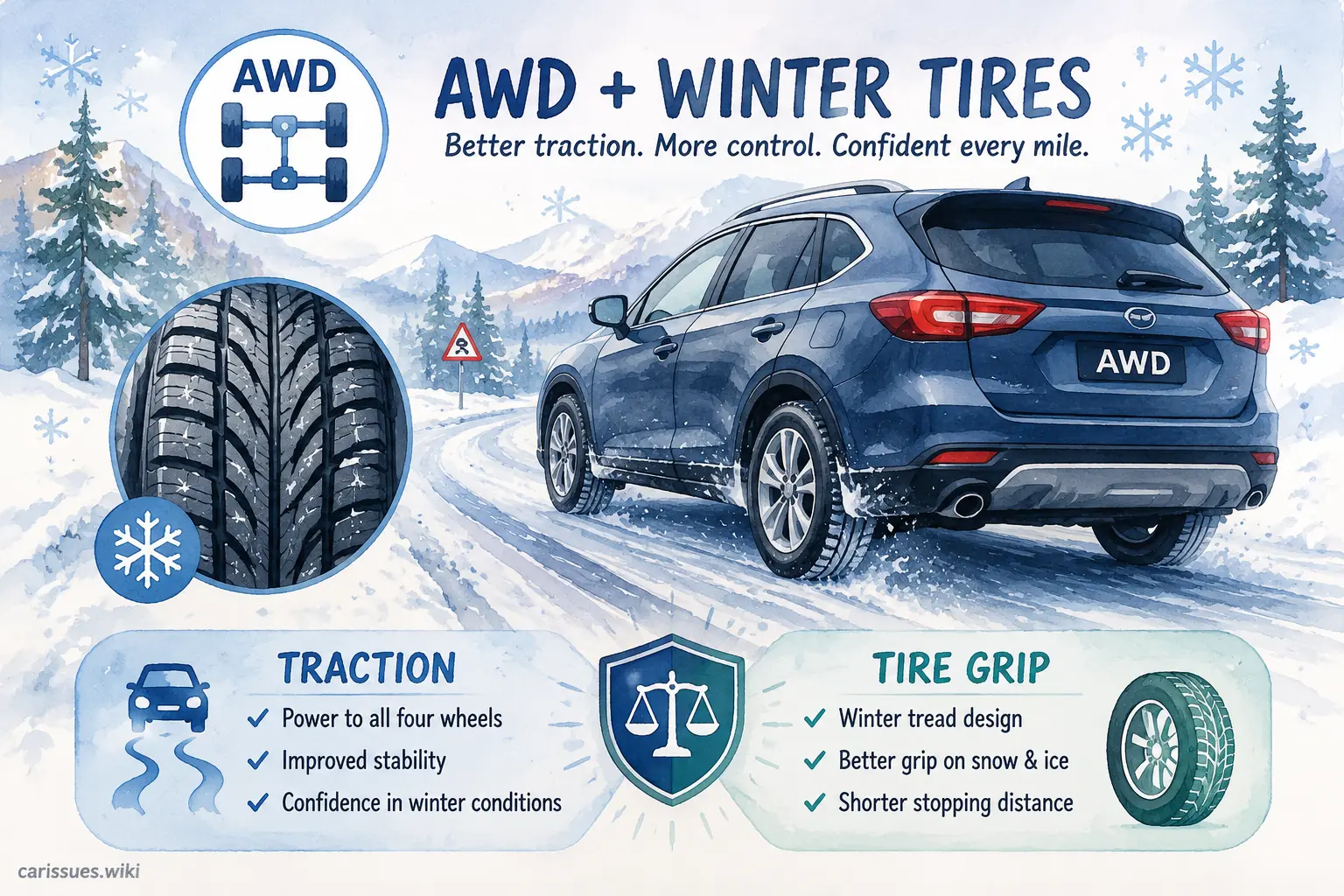
The ultimate winter setup combines AWD with dedicated winter tires. AWD maximizes acceleration traction while winter tires maximize overall grip. Together, they create a safer and more capable vehicle in snow and ice.
Here is a quick comparison:
| Setup | Acceleration | Braking | Cornering |
|---|---|---|---|
| FWD + All-Season Tires | Moderate | Weak | Weak |
| AWD + All-Season Tires | Strong | Weak | Moderate |
| FWD + Winter Tires | Strong | Strong | Strong |
| AWD + Winter Tires | Excellent | Excellent | Excellent |
This combination explains why drivers in snowy regions often swear by AWD vehicles equipped with winter tires. The pairing dramatically improves confidence and control during severe weather.
Driving Habits That Make AWD More Effective
Speed Control and Smooth Inputs
Even the best AWD system cannot compensate for aggressive driving. Smooth steering, gradual throttle application, and controlled braking remain essential during winter weather.
Rapid acceleration can still overwhelm available traction. Sudden steering movements may destabilize the vehicle. Experienced winter drivers treat slippery roads gently, almost like balancing a tray full of water.
Reducing speed is especially important. Snow-covered roads dramatically increase stopping distances, even with advanced technology. Maintaining extra following distance provides critical reaction time.
Safe winter driving is less about bravery and more about patience.
Safe Braking and Cornering Techniques
Braking should always happen earlier and more gradually in winter conditions. Modern anti-lock braking systems help maintain steering control, but they cannot shorten stopping distances on ice.
When cornering, slowing down before entering the turn is crucial. Accelerating aggressively mid-corner can overwhelm traction and cause sliding. AWD may help stabilize the vehicle slightly, but excessive speed still creates danger.
Drivers should also avoid sudden lane changes and sharp steering corrections. Smoothness is the secret weapon of skilled winter driving.
Common Myths About AWD in Winter
AWD Does Not Improve Braking
One of the biggest myths surrounding AWD is that it helps vehicles stop faster. It does not. Braking depends on tire grip and road friction.
Multiple automotive experts emphasize this point because it remains dangerously misunderstood. AWD only improves traction while accelerating.
This misunderstanding often creates false confidence. Drivers assume their vehicle is safer simply because it has AWD, then drive too quickly for icy conditions.
AWD Does Not Make Drivers Invincible
Another common myth is that AWD vehicles are immune to sliding or getting stuck. Social media is filled with videos of expensive SUVs sitting helplessly in snowbanks because their drivers ignored basic winter driving principles.
AWD improves capability, but it does not replace common sense. Tires, weather awareness, road conditions, and driver skill remain critical factors.
The smartest winter drivers respect the road regardless of how advanced their vehicle may be.
Conclusion
All wheel drive is one of the most useful technologies for winter driving, but it is often misunderstood. AWD improves traction by distributing engine power to all four wheels, helping vehicles accelerate more confidently on snow and slippery roads. Modern systems use advanced electronics, sensors, and torque management to maximize grip and stability in challenging conditions.
Still, AWD is not a magic shield against winter accidents. It does not improve braking distances, and it cannot overcome poor tires or reckless driving habits. Snow tires remain one of the most important upgrades for winter safety because they dramatically improve grip during braking and cornering.
The safest winter driving formula combines AWD, quality winter tires, and disciplined driving habits. Drivers who understand AWD’s strengths and limitations make better decisions behind the wheel and stay safer during harsh winter weather.
FAQs
1. Does AWD help on icy roads?
Yes, AWD helps improve acceleration and traction on icy roads, but it does not improve braking performance. Winter tires are still essential for maximum safety.
2. Is AWD better than 4WD in snow?
AWD is generally better for normal winter driving because it operates automatically and smoothly on paved roads. 4WD is usually more effective in deep snow or off-road situations.
3. Can AWD prevent skidding?
AWD can reduce wheelspin during acceleration, but it cannot completely prevent skidding. Excessive speed, ice, and poor tires can still cause loss of control.
4. Do AWD vehicles need winter tires?
Absolutely. Winter tires improve braking, turning, and overall traction far more effectively than AWD alone.
5. Why do AWD vehicles sometimes crash in snow?
Many AWD crashes happen because drivers become overconfident and drive too fast for conditions. AWD improves acceleration traction but does not eliminate the dangers of ice and snow.

Dorian Kessler is a 35-year-old American blogger and automotive researcher living in Boise, Idaho. With extensive experience writing educational articles about vehicle diagnostics, repair strategies, and ownership best practices, he focuses on producing content that is practical, evidence-based, and easy to understand. Through his contributions to carissues.wiki, Dorian helps readers confidently solve common car problems while maintaining high editorial standards built on expertise and credibility.