

A 12-volt battery is one of those things most people never think about until the car refuses to start, the RV lights dim unexpectedly, or the boat electronics suddenly cut out. Then comes the frantic search: “What should a fully charged 12v battery read?” The answer sounds simple at first, but once you dig deeper, battery voltage becomes a fascinating little science experiment happening right under your hood.
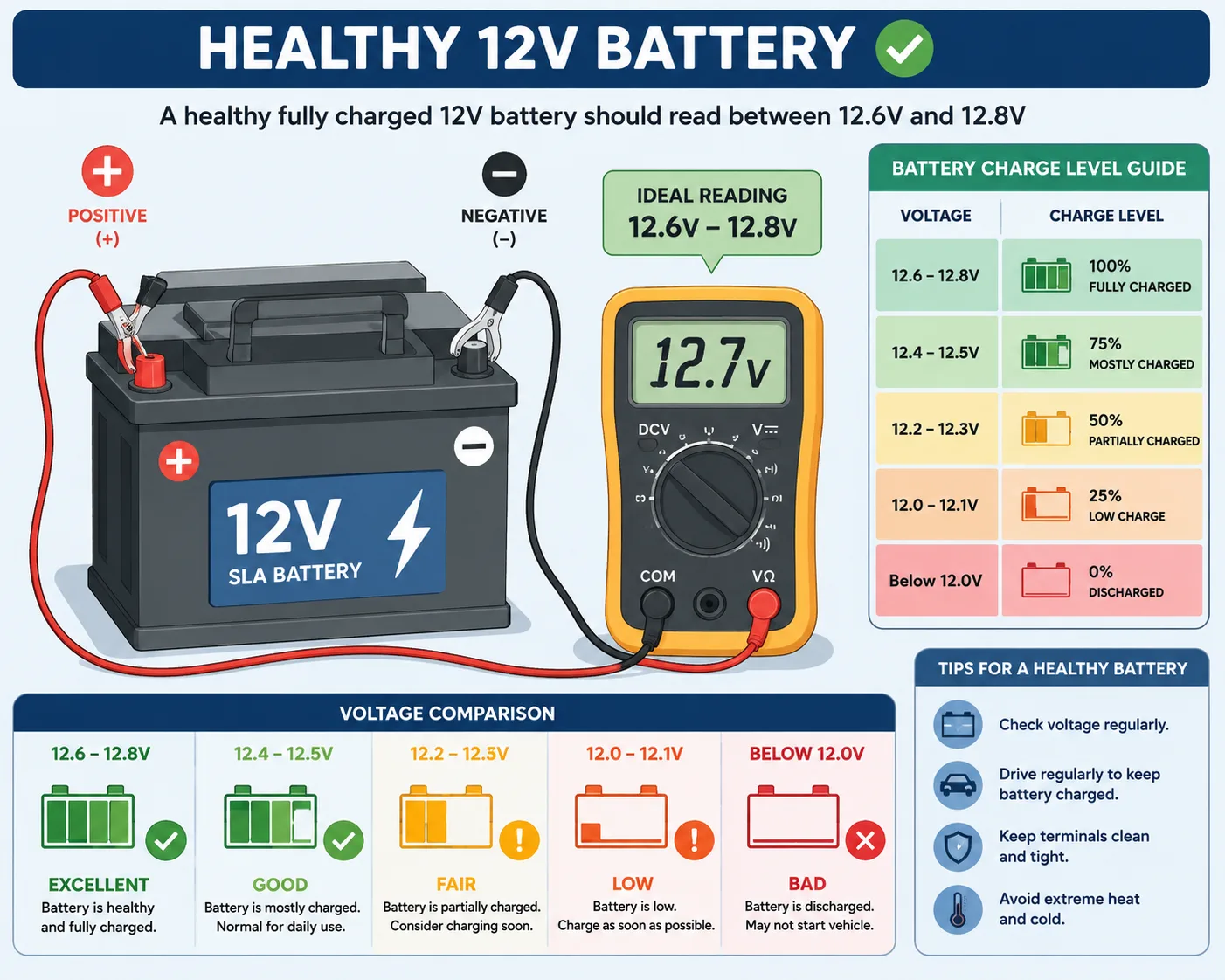
A healthy 12V lead-acid battery typically reads between 12.6V and 12.8V at rest, but that number changes depending on temperature, battery chemistry, charging conditions, and how recently the battery was used.
Understanding Why a 12V Battery Is Never Exactly 12 Volts
Here’s where many people get confused. They look at the label that says “12V battery” and assume a perfect battery should read exactly 12.0 volts. That assumption is like expecting every adult to weigh exactly 150 pounds just because they’re human. The “12V” label is simply a nominal rating, not the exact operating voltage. In reality, a healthy lead-acid battery contains six internal cells, each producing around 2.1 volts when fully charged. Add those together and you get approximately 12.6 volts.
<math xmlns=”6×2.1V=12.6V6 times 2.1text{V} = 12.6text{V}
That little difference between 12.0V and 12.6V matters more than most people realize. If your battery rests at exactly 12.0 volts after sitting unused for several hours, it is usually far from fully charged. In many cases, 12.0V suggests the battery is deeply discharged and may already be suffering internal wear. Think of voltage like a heartbeat. A healthy rhythm tells you the battery still has energy and stability, while low voltage hints that something deeper may be wrong beneath the surface.
Modern vehicles, RVs, boats, and solar systems all rely heavily on stable battery voltage. Even slight drops can confuse onboard electronics, weaken starter performance, or reduce charging efficiency. That is why professional mechanics rarely judge battery health based on a quick glance alone. They evaluate voltage in context: whether the battery is resting, charging, hot, cold, or under load. Understanding this simple concept instantly makes battery readings far less mysterious.
The Voltage Range of a Healthy 12V Battery
The healthiest resting range for a standard 12V lead-acid battery is generally between 12.6V and 12.8V after the battery has rested for several hours with no charging or load connected.
<math xmlns=”12.6V≤V≤12.8V12.6text{V} leq V leq 12.8text{V}
That “resting” condition is extremely important. Measuring voltage immediately after driving or charging can produce misleadingly high readings because of something called surface charge. Surface charge is like foam sitting on top of a freshly poured soda. It temporarily inflates the reading before eventually settling down. A battery fresh off the charger might show 13.0V or higher, but that does not mean it naturally holds that voltage long-term.
The following table gives a practical breakdown of what different voltage readings usually mean for a typical lead-acid battery at room temperature:
| Battery Voltage | Approximate Condition |
|---|---|
| 12.6V – 12.8V | Fully charged and healthy |
| 12.4V – 12.5V | About 75% charged |
| 12.2V – 12.3V | Around 50% charged |
| 12.0V – 12.1V | Low charge |
| Below 12.0V | Discharged or weak |
| Around 10.5V | Possible bad cell |
Battery chemistry also affects voltage behavior. AGM batteries often sit slightly higher than flooded lead-acid designs, while lithium-based batteries can read well above 13 volts even when resting normally. That means voltage charts are not universal across every battery type. A lithium battery at 13.2V may be perfectly healthy, while a lead-acid battery at the same reading might simply be holding leftover surface charge. Knowing your battery type matters just as much as knowing the voltage itself.
Differences Between Resting Voltage and Charging Voltage
One of the biggest causes of confusion is the difference between resting voltage and charging voltage. These are two completely different states, yet many people compare them directly without realizing it.
When the battery is resting, the voltage reflects the battery’s actual state of charge. When the engine is running or a charger is connected, the voltage naturally rises because energy is actively flowing into the battery. In most automotive systems, charging voltage typically ranges from 13.7V to 14.7V depending on alternator output, battery condition, and temperature.
<math xmlns=”13.7V≤Vcharging≤14.7V13.7text{V} leq V_{charging} leq 14.7text{V}
This is why a battery can read 14.4V while driving but later settle down to 12.7V after sitting overnight. Neither reading is wrong. They simply describe different operating conditions. It’s similar to checking someone’s heart rate while they’re sprinting versus sleeping. Context changes everything.
There are also different charging phases to understand. During the bulk and absorption stage, the charger pushes voltage higher to refill the battery quickly. Later, the charger switches into float mode, where voltage drops slightly to maintain charge without overcharging. Float voltage usually sits around 13.2V to 13.8V for many lead-acid batteries.
Some drivers panic when they see 14.5V on a running vehicle, assuming the alternator is overcharging. Often, that reading is perfectly normal. What matters is whether the voltage remains stable and falls back into the correct resting range later. Persistent overcharging or undercharging over time causes much more damage than a temporary high reading during normal charging cycles.
Why Readings Change With Temperature and Usage
Battery voltage behaves a lot like human muscles. In warm conditions, everything moves more freely and efficiently. In cold weather, performance slows down and resistance increases. Temperature has a major impact on voltage readings, which explains why batteries often fail during winter mornings.
Cold temperatures reduce the chemical activity inside the battery. Even a healthy battery may display lower voltage and weaker cranking power in freezing conditions. A reading of 12.4V on a cold morning may not necessarily indicate a failing battery. The same battery might read 12.7V later in a warm garage.
Heat creates a different challenge. High temperatures accelerate chemical reactions and can temporarily raise voltage readings, but they also speed up battery degradation internally. Long-term heat exposure evaporates electrolyte fluid and increases plate corrosion. That means a battery living in extremely hot climates may appear strong right before it suddenly fails.
Usage patterns matter too. If headlights, radios, or inverters recently drew power from the battery, the voltage may temporarily dip. After charging, voltage may remain artificially elevated due to surface charge. This is why experts recommend waiting several hours before taking a true resting measurement.
Even battery age changes voltage behavior. Older batteries develop higher internal resistance, which means voltage sags faster under load. Two batteries may both read 12.6V at rest, yet one struggles to start the engine while the other performs perfectly. Voltage alone tells only part of the story.
How to Test Voltage Accurately With a Multimeter
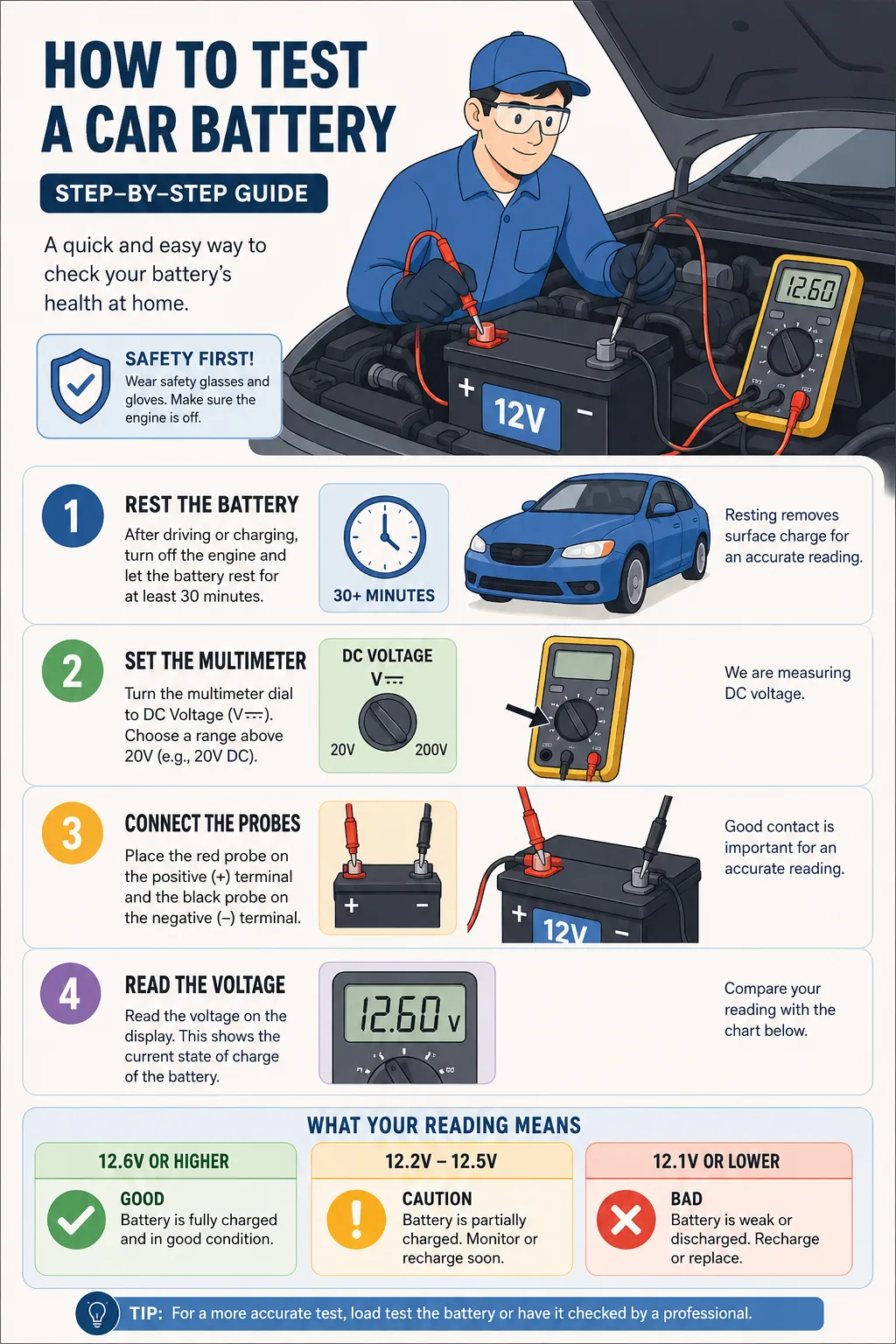
Testing a battery properly is surprisingly simple, yet many inaccurate readings happen because people skip small but important details. A digital multimeter remains the most reliable tool for checking battery voltage at home.
The first step is letting the battery rest. Ideally, wait at least four to six hours after driving or charging. Some experts even recommend overnight rest for maximum accuracy. This allows surface charge to dissipate naturally.
Next, set the multimeter to DC voltage and connect the red probe to the positive terminal and the black probe to the negative terminal. A healthy reading should appear almost immediately. If the number jumps around wildly, loose terminals or poor probe contact may be affecting the measurement.
Here’s a simple testing checklist:
- Turn off all electrical accessories
- Let the battery rest
- Set the multimeter to DC volts
- Touch probes firmly to the terminals
- Record the reading
- Compare it to a voltage chart
That sounds easy enough, right? Yet people frequently make avoidable mistakes. Testing immediately after charging creates inflated readings. Leaving headlights on during measurement lowers readings artificially. Corroded terminals can interfere with proper electrical contact. Even opening car doors during testing may wake electronic systems that slightly alter voltage.
Load testing adds another layer of accuracy. During engine cranking, healthy batteries generally stay above 9.6V at moderate temperatures. If voltage plunges below that threshold during startup, the battery may be weak despite showing decent resting voltage.
What Low Voltage Says About Battery Condition
Low voltage acts like a warning light for battery health. Sometimes it simply means the battery needs charging. Other times, it signals internal deterioration that no charger can fully repair.
Repeated readings below 12.2V suggest the battery spends too much time partially discharged. This is dangerous for lead-acid batteries because it encourages sulfation, a process where sulfate crystals harden on the battery plates. Sulfation reduces capacity and eventually prevents the battery from accepting a full charge.
A severely discharged battery may show readings under 12.0V or even below 11.8V. At that stage, the battery may struggle to power accessories or start the engine reliably. Leaving it in this state for extended periods dramatically shortens battery lifespan.
Here’s the tricky part: low voltage does not always mean the battery itself is defective. Sometimes the charging system is responsible. A failing alternator, parasitic drain, loose cable, or faulty voltage regulator can slowly drain even a healthy battery overnight. That is why professional diagnostics often examine both the battery and the charging system together.
Deep discharge events also leave long-term scars. Imagine bending a paper clip back and forth repeatedly. Eventually, the metal weakens permanently. Batteries behave similarly. Every deep discharge slightly damages internal materials, especially in standard automotive lead-acid batteries not designed for deep cycling.
If a fully charged battery quickly falls below 12.4V after sitting unused for a short period, replacement may be approaching. The battery may no longer retain energy efficiently even though it still charges temporarily.
Signs the Battery May Be Weak Despite a Full Reading
This is where battery diagnosis becomes genuinely interesting. A battery can display a “perfect” 12.6V reading and still fail miserably under real-world conditions. That happens because voltage alone measures state of charge, not overall strength or capacity.
Imagine filling a rusty bucket with water. At first glance, the bucket looks full. But the moment you carry it, water leaks everywhere. Weak batteries behave the same way. They may hold voltage briefly but collapse under demand.
Common warning signs include:
- Slow engine cranking
- Flickering headlights
- Rapid voltage drop during startup
- Electrical glitches
- Needing frequent jump-starts
- Voltage dropping quickly after charging
Load testing often exposes hidden weakness better than resting voltage alone. A battery with high internal resistance may drop sharply below 9 volts during cranking even if resting voltage looks healthy. That rapid sag reveals the battery cannot supply sufficient current anymore.
Online discussions among mechanics and battery enthusiasts repeatedly highlight this issue. Many users report batteries reading 12.7V at rest yet instantly dropping below usable voltage under load.
Capacity loss is another hidden problem. Some batteries still start engines but lose reserve power dramatically. That means accessories fail sooner when the engine is off, and voltage fluctuates unpredictably during use. Modern vehicles with sensitive electronics often expose these weaknesses earlier than older cars ever did.
Common Testing Mistakes That Lead to Confusion
Battery testing sounds straightforward, but small mistakes create massive misunderstandings. One of the most common errors is measuring voltage immediately after disconnecting the charger. That surface charge creates artificially high readings that make weak batteries appear healthy.
Another mistake is assuming all battery types share identical voltage ranges. AGM, flooded lead-acid, gel, and lithium batteries each behave differently. Comparing lithium voltage charts to lead-acid systems creates confusion instantly.
People also overlook temperature compensation. Cold weather naturally lowers voltage readings. Without accounting for ambient temperature, users may mistakenly condemn perfectly healthy batteries.
Cheap multimeters can also contribute to inaccurate results. While most digital meters work fine for basic testing, damaged leads or poor calibration may skew readings slightly. Dirty or corroded terminals create another hidden issue by increasing resistance between the meter and battery posts.
One especially misleading habit involves checking voltage while electronics remain active. Modern vehicles continue powering computers, sensors, and security systems long after shutdown. That small load can affect readings subtly. Some experts recommend waiting at least 30 minutes after shutting off the vehicle before testing.
Misunderstanding charging voltage is another major source of panic. Seeing 14.4V during engine operation is usually normal. Yet many drivers interpret it as overcharging because they expect the battery to remain near 12.6V constantly. Context matters more than the raw number alone.
Monitoring Battery Health Over Time
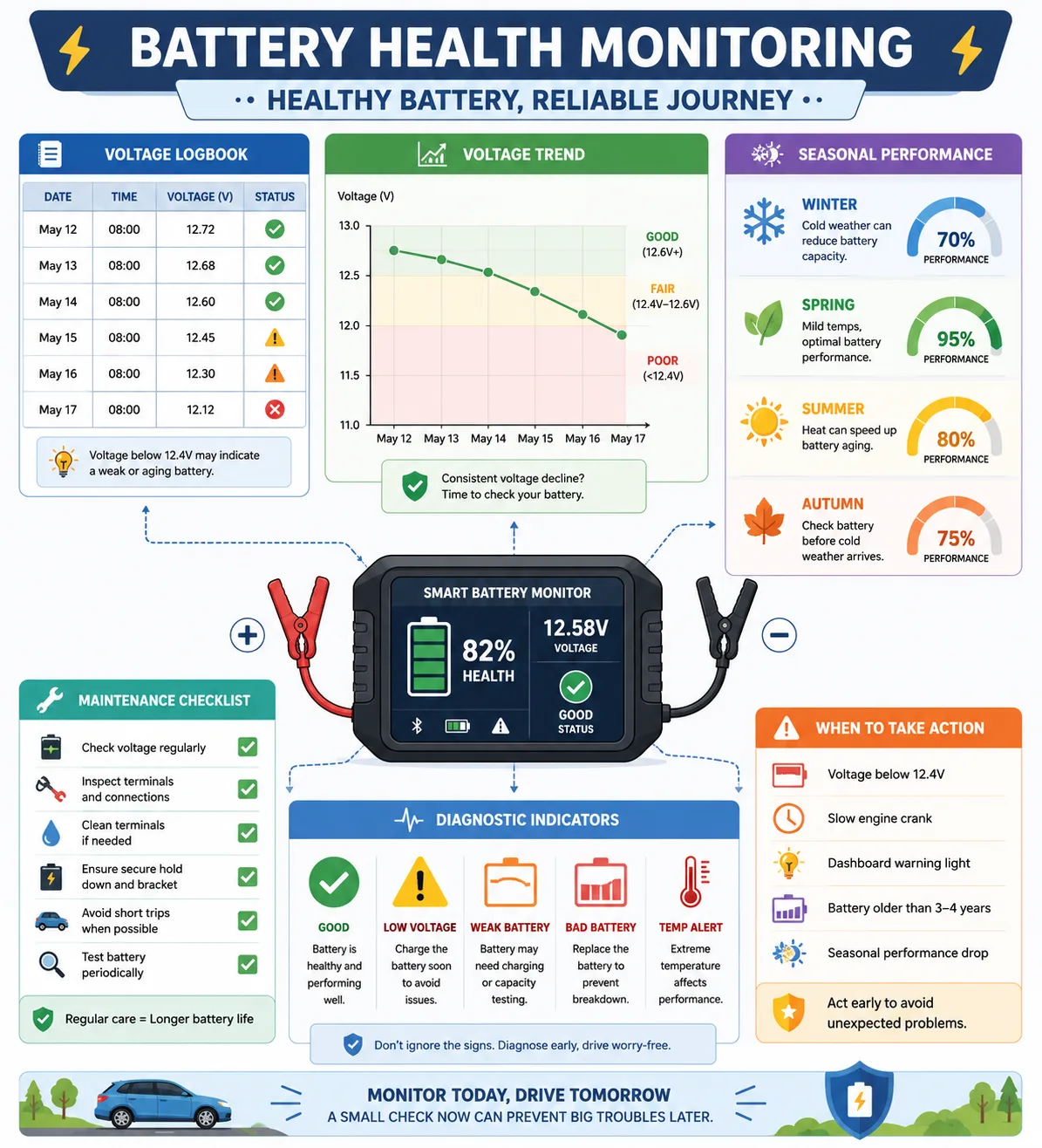
The smartest battery owners do not rely on a single reading. They monitor trends over weeks and months. A battery slowly losing resting voltage over time often reveals deterioration long before total failure occurs.
Smart battery monitors now make this easier than ever. Bluetooth-enabled monitors can track voltage history, charging cycles, and cranking performance directly from a smartphone. These tools help identify whether problems originate from the battery itself or from the charging system.
Keeping a simple voltage log also works surprisingly well. Recording resting voltage weekly allows patterns to emerge naturally. If the battery consistently drops lower after each recharge cycle, internal wear may already be progressing.
Seasonal behavior provides valuable clues too. Many batteries fail during the first cold snap because lower temperatures expose weaknesses that remained hidden during summer. A battery barely surviving warm weather may suddenly lose enough cranking power to prevent startup in winter.
Preventive habits dramatically extend battery life:
| Good Habit | Why It Helps |
|---|---|
| Keep terminals clean | Reduces resistance |
| Avoid deep discharge | Prevents sulfation |
| Charge regularly | Maintains chemical balance |
| Limit extreme heat exposure | Slows corrosion |
| Test before winter | Prevents sudden failure |
Modern battery technology has improved significantly, but no battery lasts forever. Most automotive lead-acid batteries eventually lose capacity after several years of charging and discharging cycles. Monitoring voltage trends simply gives you more control over when replacement happens instead of being surprised in a parking lot at the worst possible moment.
Conclusion
A fully charged 12V lead-acid battery should usually read between 12.6V and 12.8V at rest, while charging voltage commonly rises into the 13.7V to 14.7V range. Those numbers may shift slightly depending on battery type, temperature, recent usage, and charging conditions.
The most important lesson is that voltage alone never tells the whole story. A battery can show healthy voltage while hiding internal weakness, reduced capacity, or charging system problems. Accurate testing requires patience, proper timing, and understanding the difference between resting and active voltage conditions.
Think of battery voltage as a language. Once you learn how to interpret it, the numbers stop looking random and start revealing the true health of your electrical system. That knowledge can save money, prevent breakdowns, and help you spot trouble long before the battery finally gives up.
FAQs
1. What voltage is too low for a 12V battery?
For most lead-acid batteries, anything below 12.0V at rest is considered low. Repeatedly dropping below this range can damage the battery and shorten lifespan significantly.
2. Is 12.4 volts good for a car battery?
Yes, 12.4V generally indicates the battery is still usable and around 75% charged, though it is not fully charged.
3. Why does my battery read 13 volts after charging?
That is usually caused by surface charge. After resting for several hours, the voltage should settle closer to the true resting range.
4. Can a battery show 12.6 volts and still be bad?
Absolutely. Voltage only measures charge level, not actual strength or capacity. Weak batteries often fail under load despite healthy resting voltage.
5. How often should I test my battery voltage?
Testing every few months is usually enough for healthy systems. Before winter or long trips, checking voltage becomes especially important.

Marco Vestri is a 29-year-old American content writer based in Spokane, Washington. He specializes in creating well-researched automotive maintenance guides, troubleshooting articles, and practical ownership advice for everyday drivers. His work emphasizes accuracy, clear explanations, and reliable sources, helping readers make informed decisions with confidence. As a regular contributor to carissues.wiki, Marco combines years of blogging experience with a passion for simplifying complex vehicle topics into useful, trustworthy content for a broad audience.